

The Paris Commune, which took place from March to May 1871, represents one of the most significant experiences of popular self-management and social revolt in France. This revolutionary uprising, born in a context of war and political crisis, profoundly marked Parisian and international history, symbolizing the class struggle and the search for a new social order.
Historical context and triggering of the Commune
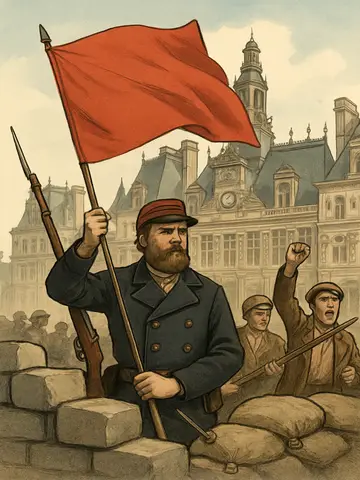
The Paris Commune was established in a particularly troubled post-war context: the humiliating defeat of France against Prussia in 1870, the fall of Napoleon III's Second Empire, and the proclamation of the Third Republic caused a political vacuum and great instability. Paris, in particular, was the scene of a strong social and political agitation, exacerbated by the Prussian encirclement and siege of the city. On 18 March 1871, the refusal of the Parisians to deliver their cannons to the government army triggered an insurrection that led to the proclamation of the Commune, an autonomous government headed mainly by workers, socialists and revolutionaries. This period was marked by a frontal opposition between an insurgent Paris and a conservative central power installed in Versailles.
Main social measures and struggles during the Commune
The Paris Commune was characterized by a series of bold social and political reforms aimed at creating a more egalitarian and democratic society. The key measures include the separation of the Church and the State, the abolition of night work in bakeries, the questioning of abusive rents and the requisitioning of abandoned workshops to hand them over to the workers. The Commune also promotes equal rights, including the right to vote for women, as well as the creation of secular and free schools. Politically, it established a direct democracy and self-organization of neighbourhoods. These social struggles were also expressed through solidarity among workers, the defence of popular interests against the versatile army, and a fierce will to emancipate against the traditional structures of power.
The Paris Commune, although brief, remains a powerful symbol of popular resistance and social experimentation. Despite its bloody repression in May 1871, it has inspired many revolutionary movements and continues to fuel debates about social justice, participatory democracy and class struggle. Its legacy continues as a reminder of the ability of peoples to mobilize to radically transform their society.