

In 1871, France went through a period of profound upheaval after the defeat against Prussia and the fall of the Second Empire. In this context of great political and social instability, the election of Adolphe Thiers to the presidency marks a decisive turning point for the country. This event is much more than just a transfer of power: it embodies the will to redefine the future of France and to rebuild a weakened but determined Republic.
The election of Adolphe Thiers as president in 1871
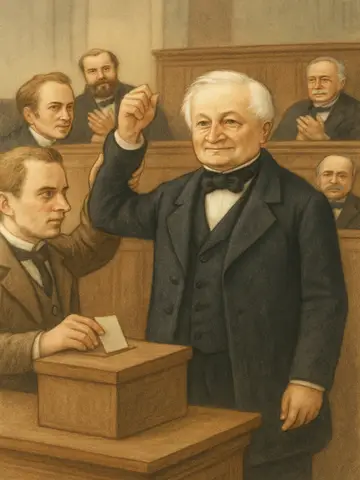
On 31 August 1871 Adolphe Thiers was elected President of the French Republic by the National Assembly, composed mainly of monarchists but wishing to stabilize the political situation. His reputation as an experienced and moderate statesman plays a crucial role in this choice. Thiers, who had already illustrated himself during the Revolution of 1848 and as a respected historian, enjoyed wide support thanks to his pragmatism and his ability to govern in times of crisis. His election came at a time when France had to face the disastrous consequences of the Franco-Prussian war, the Paris Commune which broke out shortly afterwards, and the need to establish a lasting order.
Thiers' key role in the birth of the Third Republic
Adolphe Thiers occupies a central place in the establishment of the Third Republic. As the first president of this regime, he played a role as conductor of the orchestra to ease tensions between monarchists and republicans, while consolidating republican institutions. Despite his moderate profile, he encouraged the stabilization of the country by reprimanding the Commune of Paris, which he deserved not only criticism but also respect for those who wanted a return to order. The Third Republic, under its leadership, begins to structure itself around a fragile but lasting political balance that will last until the Second World War. Thiers thus embodies the transition from a monarchical past to a republican future, laying the foundations for a modern France.
The election of Adolphe Thiers to the presidency in 1871 was a major step in French political history. Through his leadership and sense of responsibility, Thiers was able to guide France out of post-war chaos and pave the way for a solid Republic. His legacy remains that of a man who, in full torment, has been able to embody the stability and continuity of a state seeking identity.