


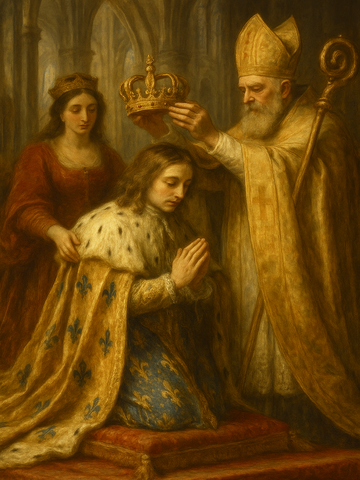
The King of France, Louis XIV, remains one of the most significant events of the seventeenth century. Celebrated in 1654 at the Cathedral of Reims, this solemn moment was not only a religious ceremony, but also a powerful manifestation of monarchical power in full consolidation. Louis XIV, then 16 years old, was to mark history with his authoritarian reign, and his crown laid the symbolic foundations of this absolute sovereignty.
The Sacre of Louis XIV: a major historical event
The Sacre of Louis XIV, held on 7 June 1654, is part of a centuries-old tradition in which the kings of France were consecrated to Reims, an emblematic city of royal power. This ritual, dating back to Clovis, the first Christian king of the Franks, gave the monarchy unwavering divine legitimacy. By choosing Reims, the ceremony highlighted the sacred link between the kingship and the Catholic Church, a strategic and spiritual alliance designed to strengthen the authority of the young Louis.
This ceremony took place in a complex political context. The kingdom barely emerged from the troubles of the Fronde, a series of nobiliary revolts that had tested the royal power. The sacre was therefore also a clear message sent to the opponents: the monarchy, embodied by Louis XIV, was ready to impose itself on a lasting basis. By this solemn consecration, Louis XIV was no longer merely an heir, but the king fully invested in his role, marked by the hand of God.
Finally, Louis XIV's sacre symbolized the beginning of an exceptional reign, which would last for more than 72 years, the longest in the history of France. This ceremony inaugurated a monarch who would centralize power, reduce the influence of nobility and impose a style of government based on absolutism. The Scripture was therefore not only a religious rite, but also a crucial step in the construction of the modern state.
Reims ceremony: royal traditions and symbols
The ceremony of the Sacre in Reims followed a thorough protocol, rich in symbols and ritual gestures. Upon his arrival at the cathedral, Louis XIV was greeted by a religious procession and the crowd came to attend this historic event. The cathedral, a Gothic jewel, offered a solemn and sacred setting, reinforcing the mystical dimension of intronization. For several hours, the young king took part in rites deeply charged with meaning, intended to emphasize his role as lieutenant of God on Earth.
One of the most important moments was the royal anointing, where the archbishop of Reims applied Holy Chremia to the forehead, chest and hands of Louis XIV. This holy oil, symbol of purity and divine mission, marked the Prince's transformation into a sacred king. By this anointing, the king became the « Anointed by the Lord »protected and guided by the divine will. This ritual stage gave the monarch a singular status, combining temporal power and sacrality.
The royal insignia, such as the crown, the scepter, the hand of righteousness, and the sword of Charlemagne, were handed over to the king during the ceremony. Each object symbolized one aspect of its authority: justice, strength, wisdom and historical continuity. All these gestures and objects reflected an alliance between temporal and spiritual, assuring that Louis XIV would not only be a head of state, but also a living symbol of the unity and grandeur of the kingdom.
Louis XIV's sacre at Reims in 1654 was much more than just a ceremony. He represented the perpetuation of a royal tradition based on the divine, while marking a major political turning point in the history of France. By combining mysticism and power, this ceremony laid the foundations of the absolutist reign that would transform the monarchy and the entire country. Even today, this event remains a key step in understanding the influence and influence of Louis XIV, the « Sun King »on the European scene and beyond.