


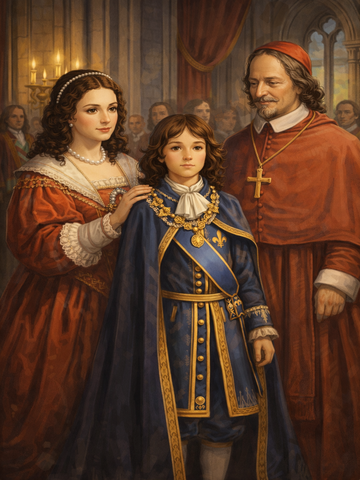
14 May 1643 marked a major turning point in the history of France: the death of Louis XIII and the accession to the throne of his son, Louis XIV, who was only four years old. This situation — a child king — leads to a period of political and institutional transition that will shape the French monarchy in a lasting way. For students, understanding the causes and stakes of this moment, as well as the role of the regency of Anne of Austria and her advisers, is essential to grasp the birth of modern monarchy power.
The causes and stakes of the beginning of the reign (1643)
The immediate cause of the change of reign is the disappearance of Louis XIII after a long illness. His death left the kingdom ruled by a minor heir and forced a regency, which created a fragile political situation. Institutions must adapt: the Queen Mother becomes regent, but the real balance of power depends largely on the councillors and ministers who surround the young sovereign.
At the international level, France is still engaged in the vast series of conflicts related to the Thirty Years War. The state pursues the strategic objective of reducing the influence of Habsburg (Spain and the Holy Empire) in Europe. Continuing this military policy is expensive: war spending is heavily burdening public finances and causing social and fiscal tensions within the kingdom.
Finally, domestic issues are important: the centralization initiated under Richelieu meets the resistance of the great feudals, parliaments and cities. Administrative reforms (intendants, limitation of seigneurial privileges) and requests for funding cause political discontent and tension. The regency must therefore navigate between the need to maintain royal authority, pursue foreign policy and contain growing oppositions that will eventually break out in the Fronde a few years later.
Louis XIV child and regency of Anne of Austria
Louis XIV, born on 5 September 1638, grew up in a context where his status was both sacred and fragile: sacred because the monarchy was still endowed with religious and dynastic legitimacy, fragile because a child could not govern. His mother, Anne of Austria, assumed regency and received the support of a small group of faithful, among whom Cardinal Mazarin played a decisive role as principal adviser and statesman. It is this duo that ensures the continuity of royal power during the king's minority.
The education of the future Louis XIV is organized to make him an enlightened and firm monarch. He is taught religion, Latin, history and military arts, but also the idea of a strong and centralized monarchy. Mazarin and Anne seek to rule out influences deemed dangerous and to form a king capable of regaining power in full maturity. The days of the young Louis alternate between the ceremonial of the court, instruction and care related to his age, while the court remains a place of struggle of influence.
The regency is also marked by crises: fiscal pressure, parliamentary conduct and rivalry of the greats are manifested in disputes that will soon culminate with the Fronde (1648-1653). Louis, witness to these events in his childhood, saw the test of power in formation: he observed the setbacks, humiliations and displacements of the court. These experiences forge his personality and explain in part why, as an adult, he will choose a policy of strong personal power and strict control of the nobility.
The beginning of Louis XIV's reign in 1643 opened a decisive period for the French monarchy: between the continuity of Richelieu's policies, financial challenges and internal challenges, the regency of Anne of Austria and Mazarin's influence paved the way for the transformations that would lead to royal absolutism. For students, studying these years means understanding how concrete circumstances — the death of a king, the minority of an heir, costly wars — can shape a country's political institutions and attitudes in a sustainable way.