


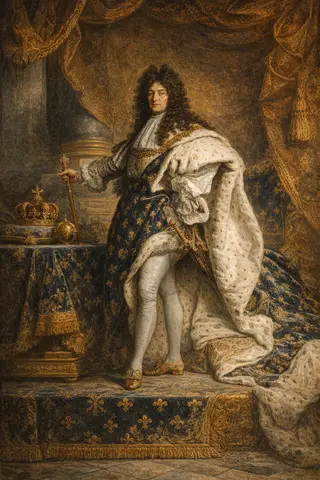
The personal reign of Louis XIV, which began in 1661 after the death of his Cardinal Mazarin, marks a crucial milestone in the history of the French monarchy. This moment symbolizes the king's direct seizure of power, without the intermediary of a regent or prime minister, and announces a period of strengthening of royal authority. Louis XIV, nicknamed the Sun King, then embarked on a centralizing and absolutist policy that would shape France's face for a long time.
The advent of the personal reign of Louis XIV in 1661
In 1661, at the age of 23, Louis XIV decided to rule alone after the disappearance of Mazarin, who had ensured regency during his minority. This decision marks the end of the influence of powerful ministers and the beginning of a reign where the king fully embodies sovereign power. Louis XIV chose not to appoint a Prime Minister, affirming his will to exercise direct control over the state. This choice is based on his conviction that absolute monarchy is the best bulwark against the internal divisions and power conflicts that had weakened France during the previous reigns.
The King's first political and administrative measures
From the beginning of his personal reign, Louis XIV initiated a series of reforms designed to strengthen the unity and authority of the kingdom. He centralized the administration by increasing the role of stewards, royal agents responsible for supervising the provinces on behalf of the king, thereby reducing the power of the noble locals. In addition, it is reforming justice to ensure greater uniformity and to strengthen the submission of sovereign courts to its authority. Financially, he relies on Jean-Baptiste Colbert to improve the management of public finances, promote the development of trade and encourage manufacturing production, laying the foundations for an efficient and prosperous monarchy.
The personal reign of Louis XIV, begun in 1661, is a founding period that illustrates the triumph of royal absolutism in France. By imposing itself as the undisputed master of the state, the Sun King lays the foundation for a centralized and powerful political system, whose repercussions will be felt for more than a century. This moment also marks the beginning of an era in which the French monarchy affirms itself as a model of absolute power and international prestige.