


Scientific and geopolitical context before 1967
Prior to 1967, knowledge of the dynamics of the Earth was limited and fragmentary. The theory of continental drift, proposed by Alfred Wegener in 1912, remained controversial due to the lack of a convincing explanatory mechanism. The cold war encouraged the intensification of oceanographic research, particularly by the United States and the USSR, pushed to understand the seabed for strategic reasons. This period also saw the development of underwater magnetic measurement technologies, essential for the future validation of plate tectonics. The absence of a unified model delayed the understanding of major geological phenomena such as earthquakes, volcanoes and mountain formation.
Discovery and impact of tectonic plate theory
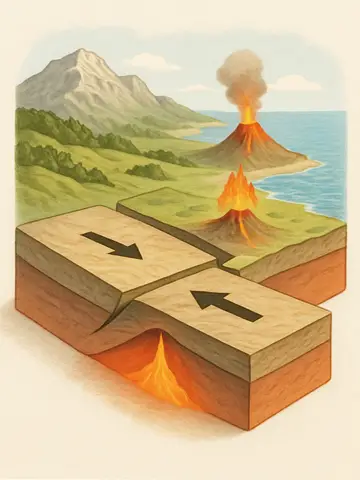
In 1967, the theory of tectonic plates, formulated by John Tuzo Wilson and consolidated by geophysicists such as Vine and Matthews, revolutionized geology. She explains that the Earth's lithosphere is divided into rigid plates moving over the asthenospheric sphere. This model is based on evidence such as earthquake distribution, ocean ridge topography and symmetry of magnetic anomalies on the seabed. The theory replaces the drift of continents and becomes a central paradigm, transforming the study of geological processes. Its immediate applications concern the prevention of natural hazards and mineral and oil exploration. This epistemological change also influences environmental policies and international scientific cooperation during the Cold War.
Historical links: This scientific advance builds on Wegener's previous work (1912), takes advantage of the cold war-related oceanographic campaigns (1950-60s) and prepares the understanding of major earthquakes such as Tangshan in 1976. It is also a prelude to planetary geology, with the study of tectonics on Mars and other celestial bodies.