


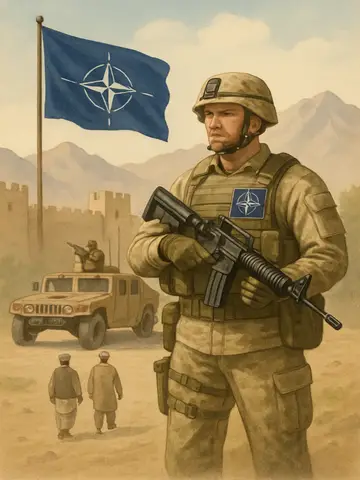
The intervention in Afghanistan in 2001, largely conducted under NATO auspices, represents a major turning point in international policy after 11 September. The operation, initiated in response to the terrorist attacks against the United States, was aimed at dismantling the Al-Qaeda network and overthrowing the Taliban regime that served as its refuge. This paper proposes to review the context and causes of this intervention, as well as the role NATO played in the region in the years that followed.
Background and intervention in 2001
The intervention in Afghanistan was triggered by the attacks of 11 September 2001, which profoundly affected the United States and the international community. These terrorist attacks, orchestrated by Al-Qaeda under the protection of the Afghan Taliban, led Washington to seek permission to launch a military action to neutralize this group. Afghanistan, then under Taliban control, was considered a dangerous sanctuary for international terrorists. The Taliban's refusal to deliver Osama bin Laden has pushed an international coalition, led by the United States but quickly supported by NATO, to intervene militarily in order to destroy terrorist bases and establish a more stable and legitimate regime.
NATO's role and actions in Afghanistan after 2001
Following the launch of US military operations, NATO formalized its engagement in Afghanistan in 2003 by assuming command of the International Security Assistance Force (ISAF). The main objective of the mission was to support the Afghan Government in securing the territory and rebuilding the country. NATO deployed troops in several provinces, conducting combat operations against the Taliban insurgents, while contributing to the formation of the Afghan armed forces. Over the years, this intervention has become more complex, integrating civilian components such as the promotion of democratic governance, infrastructure development and the protection of human rights. Despite the persistent challenges, NATO played a central role in trying to stabilize the country until its gradual retirement from 2014.
NATO's intervention in Afghanistan from 2001 marked a key step in the fight against international terrorism, while stressing the difficulties of a protracted military operation in a deeply fractured country. While it has allowed the Taliban to dislodge power and weaken Al-Qaeda, this intervention has also highlighted the complexities of rebuilding a state and lasting peace. With hindsight, the Afghan experience remains an important lesson for the international community on the limitations and challenges of multilateral military interventions.