

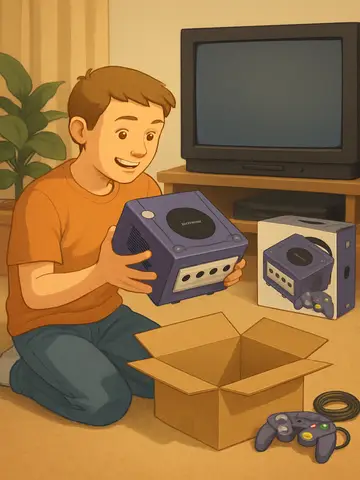
The release of the GameCube in 2001 marks a major turning point in the history of video game consoles. Nintendo, after the phenomenal success of the Nintendo 64, decides to return to the front of the stage with a console with advanced technical features and a unique design. This new machine aims to offer a more immersive gaming experience while maintaining the fun spirit that made the brand famous.
Launch of the GameCube: a new era for Nintendo
In September 2001, Nintendo officially unveiled the GameCube, a compact and innovative console that stands out for its cube-shaped format, hence its name. Designed to compete with Sony's PlayStation 2 and Microsoft's Xbox, the GameCube features a mini-DVD player and high-performance graphic architecture, promoting enhanced graphics and increased gaming fluidity. With iconic games like « Super Smash Bros. Melee » and « The Legend of Zelda: The Wind Waker » In preparation, Nintendo seeks to seduce a wide audience, ranging from occasional players to long-time fans. The launch is also accompanied by a targeted marketing campaign, highlighting the user-friendliness and power of the console.
Reactions and successes from the release in 2001
The arrival of the GameCube in the market is welcomed with notable enthusiasm, although the competition is harsh. The first returns salute the quality of the games available and the handling of the controllers, considered comfortable and ergonomic. However, some critics point to the choice of mini-DVD format, limiting storage capacity compared to other consoles. Despite this, the GameCube was able to quickly win thanks to a strong catalogue and a community of loyal players. Initial sales are encouraging, notably in Japan and North America, where Nintendo has a loyal fan base. The launch thus marks the beginning of a new era for the company, which continues to strengthen its position in the video game industry.
The release of the GameCube in 2001 is a key moment for Nintendo, symbolizing both a technological evolution and a desire to renew its approach to the game. Despite intense competition, the console was able to find its audience thanks to a balance between innovation and respect for traditional brand values. More than just an object, the GameCube embodies a period rich in creativity and passion for players around the world.