


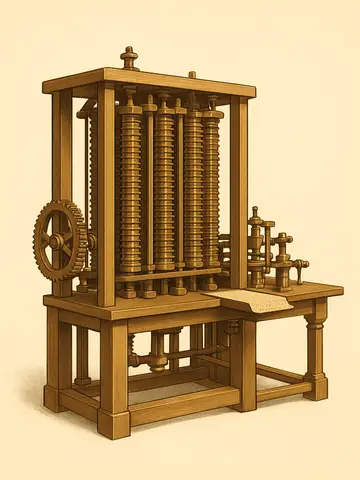
The Analytic Machine, designed in 1822 by Charles Babbage, represents a fundamental step in the history of computer science. Long before the era of electronic computers, Babbage imagined a machine capable of performing complex calculations automatically, thus laying the foundations of the modern concept of the programmable computer. This article explores the origins of this visionary invention and the major innovations it has brought.
The genesis of the Analytic Machine in 1822
It was in 1822 that Charles Babbage embarked on the design of the Analytic Machine, originally called « Difference machine ». His idea was to create a mechanical device capable of automating mathematical table calculations, often subject to human errors. Inspired by the work of Joseph-Marie Jacquard, who used perforated cards to control looms, Babbage integrates this concept to make his machine programmable. This first draft marks the beginning of an ambitious project to revolutionise scientific and commercial computing.
Major innovations of Babbage Analytics Machine
The Analytic Machine had to integrate several major innovations that differentiated it from the computational devices of the time. It included a calculation unit (the « mill »), a data storage memory, an input and output device based on perforated cards, and a control system for performing conditional and repetitive operations. In short, Babbage has designed a prototype computer for general use, capable not only of calculating but also of dealing with complex instructions. Although the machine was never completed during its lifetime, its concepts profoundly influenced the further development of computer science.
The 1822 Analytic Machine remains a symbol of innovation and avant-garde vision. Charles Babbage's genius paved the way for a world where machines could go far beyond simple calculations, opening the door to the modern digital age. Its legacy continues to inspire researchers and engineers, recalling that true technological advancement often arises from the audacity of thinking differently.