


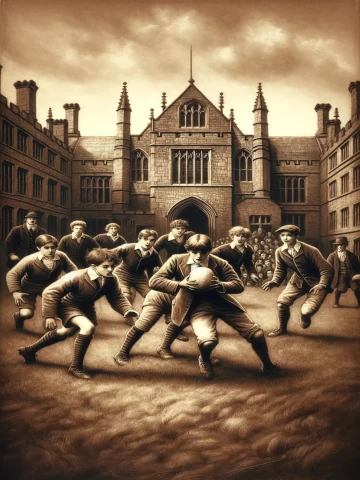
Rugby, today a world-renowned sport, draws its roots from a story mixed with facts and legends. Among these, the date of 1823 holds a special place, often cited as the moment when this sport came into being. That year, a mythical event would have taken place in Rugby School, England, marking the beginning of a new exciting discipline. Back to the legend of the origin of rugby and the fascinating role of William Webb Ellis.
The mythical origins of rugby in 1823
The year 1823 is often considered as the founding moment of rugby. According to oral tradition, during a football game played at Rugby School, a student decided to take the ball by hand and run with it, thus challenging the usual rules of the game. This bold gesture would have given rise to a new way of playing, distinct from traditional football. Although the historical archives lack concrete evidence, this anecdote has become a true legend, symbolizing the spirit of innovation and courage that characterizes rugby.
William Webb Ellis: The legendary inventor of rugby
At the heart of this story is William Webb Ellis, a young student of Rugby School who is credited with this revolutionary gesture. According to the story, in 1823 Webb Ellis seized the ball with his hands during a football game, breaking the rules. This moment is now celebrated as the exact moment when rugby was born. Although some historians dispute this version, highlighting the absence of contemporary testimonies, Webb Ellis remains an emblematic figure, often honored as the mythical inventor of rugby.
The legend of the origin of rugby in 1823, centered on William Webb Ellis, embodies the spirit of this sport: daring, innovation and team spirit. Whether it is entirely true or embellished over time, this story has given rugby a strong identity, inspiring generations of players and fans around the world. Thus, each match played today perpetuates this tradition born of a simple gesture, a symbol of universal passion.