

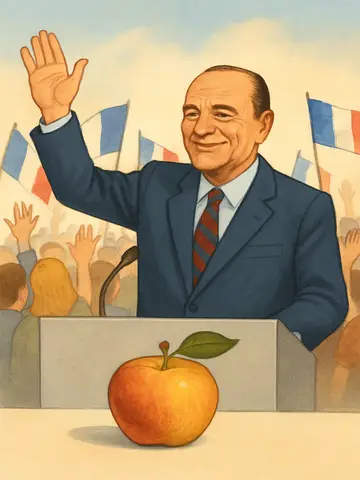
Jacques Chirac is an essential figure in French politics of the 20th century. In 1995, after a long political career marked by several ministerial mandates and his role as mayor of Paris, he became President of the Republic. His election marks an important turning point in French political life, illustrating a desire for change while building on a solid experience.
Jacques Chirac wins 1995 presidential election
The 1995 presidential election was a key moment for Jacques Chirac. Faced with intense competition, notably with outgoing Prime Minister Édouard Balladur, Chirac has been able to mobilize a wide range of voters through a speech focusing on social justice and the fight against exclusion. His campaign highlighted his image as a grouper and man of the people, which resonated with a France in search of renewal. On 7 May 1995, he won the second round with about 52.6% of the vote, becoming the seventh president of the Fifth Republic.
Chirac's first steps to the Elysée and his political priorities
On his arrival at the Élysée, Jacques Chirac set several major priorities. Aware of the expectations of the French, he stressed the reduction of unemployment and the fight against inequalities, while affirming his will to preserve France's place on the international scene. It also launched a policy of « social divide » to combat economic and social disparities. At the external level, Chirac seeks to strengthen the European Union and maintain French influence in the world, notably through an independent foreign policy. These first steps are marked by a desire to reconcile stability and reform.
The election of Jacques Chirac in 1995 is part of a transitional period for France. His presidency reflects a time when the French sought to reconcile tradition and modernity, while facing major social and economic challenges. Chirac will leave a lasting imprint in French political history, embodying both pragmatism and the vision of a country on the move.