


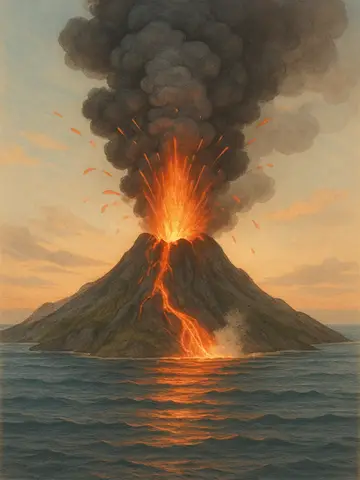
The eruption of Krakatoa in 1995 is a notable volcanic event that recalled the ever-present power of this iconic volcano located in Indonesia. Less dramatic than the cataclysmic eruption of 1883, this volcanic manifestation nevertheless had a significant impact on the local environment and confirmed the continued activity of this volcano. In this paper, we will first explore the geological context of this eruption before examining its environmental consequences and impacts.
Geological context of the Krakatoa eruption in 1995
Krakatoa is part of the Indonesian volcanic arc, a subduction zone where the Indo-Australian plate dives under the Eurasian plate. This active tectonic causes a partial fusion of the terrestrial mantle, thus feeding volcanoes like Krakatoa. After the cataclysmic eruption of 1883 which almost completely destroyed the island, a new island called Anak Krakatau (Krakatoa Child) was born in the middle of the Sound Strait. The 1995 eruption was characterized by moderate explosive activity, with ash emissions and lava flows, reflecting the reactivation of the magmatic chamber under the new volcanic structure. This phenomenon is part of the continuous volcanic dynamics that shape the island landscape and regional geology.
Environmental consequences and impacts of eruption
The 1995 eruption, although less destructive than the one of 1883, had significant environmental impacts. Volcanic ash emissions have temporarily darkened the sky and affected air quality in the surrounding areas, while fallout has temporarily altered the chemical composition of soils and neighbouring waters. In addition, lava flows have remodelled parts of Anak Krakatau Island, creating new geological habitats. This activity also influenced local wildlife, disrupted some marine and terrestrial ecosystems, but also offered new ecological niches. Overall, the eruption demonstrated Krakatoa's ability to exert a significant environmental influence, even in moderate-intensity episodes.
The eruption of Krakatoa in 1995 recalls that this volcano remains a dynamic natural force, capable of transforming its environment at any time. Although it has not reached the dramatic scale of past events, this eruption has nevertheless reinforced the scientific vigilance around this active volcanic site and its role in the geological and environmental evolution of the region. Krakatoa continues to be a natural laboratory to understand the interactions between volcanoism, ecosystems and human societies.