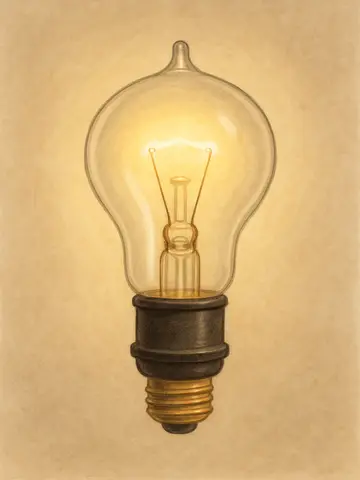
The invention of the light bulb by Thomas Edison in 1876 marked a major revolution in lighting. Before this innovation, light sources were mainly based on fuels such as oil, gas or candles, which presented fire risks and limited efficiency. Thanks to his hard work and numerous experiments, Edison succeeded in creating a durable and functional light bulb that would profoundly transform the way humans illuminate their spaces.
Invention of the light bulb by Thomas Edison
In 1876, Thomas Edison developed an electric light bulb that was distinguished by its longevity and reliability, two essential qualities for sustainable domestic and industrial lighting. Unlike its predecessors, Edison used a carbon filament, enclosed in a vacuum glass ampoule, thus limiting oxidation and increasing the lamp's lifetime. This technical innovation, the result of numerous experiments, produced a stable and continuous light, accessible to a wide public. Edison was not content with the invention alone: he also developed a complete electrical lighting system including generators and distribution networks, thus laying the foundations of modern electricity.
Impact of the 1876 bulb on modern lighting
Edison's light bulb had a profound impact on society and economy, making night lighting possible in houses, streets and workplaces. This led to longer hours of daily activity, thereby improving productivity and quality of life. Moreover, the light bulb became a symbol of technological progress and paved the way for a multitude of innovations in the field of electrotechnics. By replacing traditional light sources, it also reduced fire risks and combustion-related pollution. Today, although technologies have evolved towards more energy-efficient light bulbs, Edison's fundamental principle remains the cornerstone of contemporary electrical lighting.
The light bulb invented by Thomas Edison in 1876 remains one of the greatest technological innovations in history. It not only changed our relationship to light, but also initiated a complete transformation of modern industrial and urban society. By enlightening the night, Edison literally lit the way to the modern world we know today.