


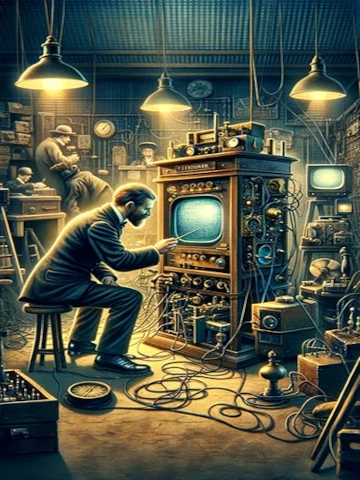
The invention of television in 1925 marks a revolutionary step in the history of communications. This device would transform the way information and entertainment were disseminated, bringing individuals closer together through the transmission of moving images. A review of the first ideas that led to this major invention and the emblematic figures that made this technological breakthrough possible.
The first ideas behind television in 1925
At the beginning of the twentieth century, the idea of transmitting images remotely fascinated many inventors and scientists. In 1925, television was still an avant-garde concept, based on the concept of decomposing an image into small elements and reconstructing them into a distant point. This idea was based on techniques of analysis and image synthesis, combining electricity, optics and mechanics. The 1925 year is often considered a turning point because it saw the first concrete demonstrations of the transmission of an image in motion, paving the way for a real visual revolution.
Key inventors and their major contributions
Two figures dominated the invention of television in 1925: John Logie Baird, Scottish engineer, and Philo Farnsworth, American inventor. John Logie Baird is famous for making the first transmission of a moving television image in October 1925, using a mechanical system based on a rotating disc. For his part, Philo Farnsworth was working on a fully electronic system, more flexible and promising. These pioneers laid the technical foundation for the rapid development of television, both industrially and commercially, in the following decades.
The invention of television in 1925 is the result of a mixture of ingenuity, passion and perseverance. The first ideas and experiments of this time laid the foundation for a media that would upset modern society. Thanks to the efforts of visionaries such as John Logie Baird and Philo Farnsworth, television has become an essential tool, able to connect people and open new cultural and informative horizons.