


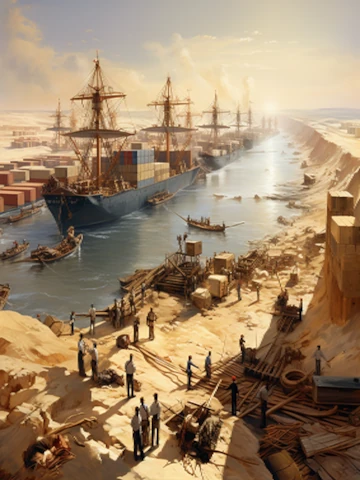
The construction of the Suez Canal, completed in 1869, represents one of the most significant engineering achievements of the 19th century. This colossal project, which has transformed world trade and international relations, took several years of hard work, overcoming considerable technical and human obstacles. Back to the beginnings of the canal, its challenges, its inauguration and its lasting impact.
The beginnings and challenges of canal construction
The idea of linking the Mediterranean Sea to the Red Sea to facilitate trade between Europe and Asia was not new, but it was under the impetus of Ferdinand de Lesseps that the project really took shape. From the beginning of the work in 1859, engineers had to face major difficulties: desert terrain, water management, and extreme weather conditions. The labour force, made up largely of Egyptian workers and foreign workers, suffered from illness and exhaustion. Despite these obstacles, modern techniques of digging and water management have made progress, making the canal an unprecedented technical feat for the time.
The inauguration and global impact of the Suez Canal
On 17 November 1869, the Suez Canal was officially inaugurated in a large pump, bringing together dignitaries, engineers and international representatives. This opening revolutionised maritime transport by considerably reducing the journey between Europe and Asia, avoiding the long detour through the Cape of Good Hope. The Canal quickly became a strategic axis for world trade, promoting economic growth and the spread of cultural exchanges. Moreover, it has had major geopolitical repercussions, notably by strengthening European influence in Egypt and the Middle East.
The construction of the Suez Canal in 1869 marked a turning point in the history of global infrastructure. More than just a maritime passage, it has become a symbol of innovation and international cooperation while shaping global economic and political dynamics in a sustainable way. Even today, there remains a vital element of global maritime trade, recalling the audacity and determination of those who made this feat possible.