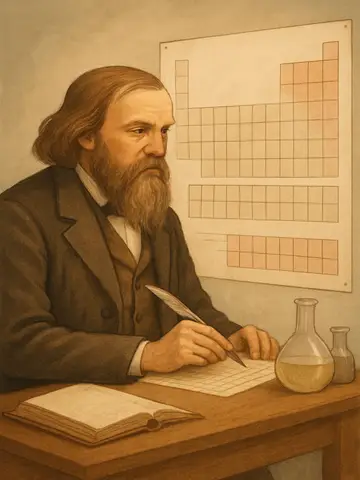
The discovery of the periodic painting by Dmitri Mendeleyev in 1869 marks a major step in the history of chemistry. This systematic organization of chemical elements has not only provided a better understanding of their properties, but has also paved the way for many scientific advances. A review of the genesis of this revolutionary invention and its lasting impact.
The genesis of the periodic table by Mendeleyev
In 1869 Dmitri Mendeleyev, a Russian chemist, developed the first periodic table by classifying known chemical elements according to their atomic mass and chemical properties. His approach was innovative: he even left empty spaces in his painting, predicting the existence of elements still unknown at his time. This visionary approach allowed several anomalies in the classification of elements to be corrected and the characteristics of new elements to be predicted, reflecting a deep understanding of the links between materials.
Revolutionary impact of discovery in 1869
The publication of the periodic table had an immediate and profound impact on chemistry and the natural sciences. By providing a clear and predictable framework, he facilitated the research and identification of new elements, while structuring the teaching of chemistry around the world. Mendeleyev's ability to anticipate the properties of unknown elements strengthened the scientific credibility of his painting, which quickly became an indispensable tool for researchers and remains today the fundamental basis of modern chemistry.
The discovery of the periodic painting by Mendeleyev in 1869 transformed our understanding of matter. By classifying the elements in a coherent and forward-looking manner, he laid the foundation for a more rigorous and open scientific discipline for discovery. His work continues to inspire chemists and scientists, illustrating how well structured an idea can change the course of scientific history.