


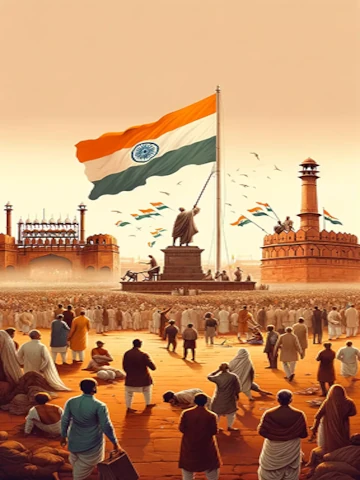
India's independence in 1947 was a pivotal moment in world history, marking the end of nearly two centuries of British colonial rule. This process, which was long and complex, not only liberated an immense nation but also redesigned the political map of South Asia. This event is the result of fierce struggles led by millions of Indians, inspired by iconic leaders such as Mahatma Gandhi and Jawaharlal Nehru, who dreamed of a free, united and sovereign country.
The Path to India's Independence in 1947
India's independence was the result of a long struggle of decades, punctuated by popular movements and intense political negotiations. From the 19th century, Indian nationalism began to organize against British domination, culminating in the creation of the Indian National Congress in 1885. Resistance took on a new dimension with Gandhi's campaign of civil disobedience in the 1920s and 1930s, advocating non-violence and passive disobedience. After the Second World War, Britain, weakened economically and politically, agreed to transfer power. However, religious differences between Hindus and Muslims led to the partition of the country into two independent states, India and Pakistan, which was formalized on 15 August 1947.
The major consequences of partition and freedom
India's partition led to dramatic upheavals, marked by unprecedented community violence and mass exodus. More than 10 million people were displaced, often in tragic conditions, while hundreds of thousands lost their lives in interreligious clashes. At the political level, India became the largest democracy in the world, adopting a constitution in 1950 that guaranteed fundamental rights to its citizens. Despite the challenges of national unity and economic development, independence allowed India to forge its own identity and play a leading role on the international stage.
India's independence in 1947 remains a powerful symbol of struggle for freedom and dignity. Although marked by deep pains due to partition, this date embodies the hope of a nation that rose up against colonial oppression to trace its own destiny. Even today, this legacy continues to inspire the peoples of the world in their quest for justice and self-determination.