

The Cold War, a major ideological and political conflict of the twentieth century, was rooted in the events that followed the Second World War. The year 1947 marks a decisive turning point where tensions between the Eastern Communists, led by the Soviet Union, and the capitalist West, led by the United States, begin to crystallize. This new antagonism, which was to last several decades, is rooted in deeply opposed worldviews and strategic rivalries arising from the consequences of the global conflict.
The ideological origins of the East-West conflict in 1947
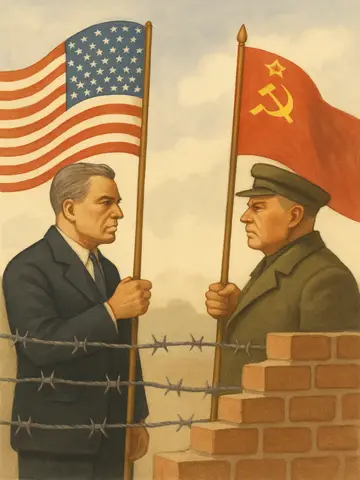
The ideological origins of the Cold War in 1947 were primarily related to the confrontation between two rival political and economic systems: democratic capitalism and authoritarian communism. On the one hand, the United States defended a model based on individual freedom, market economy and parliamentary democracy. On the other hand, the Soviet Union promoted a centralized socialist society, where the state controlled the means of production and where the Communist Party held absolute power. These conflicting visions of how to organize society and the economy have created a climate of mutual distrust, with each side seeing the other as a threat to its way of life and security. The Truman doctrine, announced in 1947 to contain communist expansion, is a perfect example of this ideological opposition that was to structure international relations in the years to come.
The first diplomatic tensions after the Second World War
After the end of World War II, the victorious powers soon found themselves confronted with major differences on the reconstruction of Europe and the world order. In 1947, the first diplomatic tensions intensified: the Soviet Union imposed its control over the Eastern European countries, while the United States supported the economic reconstruction of the West through the Marshall Plan. This massive aid programme aims to stabilise European economies and prevent the rise of communism in these regions. Moreover, the question of divided Germany becomes a strong symbol of East-West divisions. The distribution of areas of occupation and the creation of separate economic zones fuel rivalries. These differences also manifest themselves in international forums, particularly at the United Nations, where the Soviet vetoes and American actions reflect a diplomacy of increasing confrontation. Thus, 1947 appears as the year when alliances freeze and the beginnings of a long cold war become visible.
The year 1947 represents the formal starting point of an unprecedented ideological and political confrontation, which would dominate the international scene for almost half a century. The root causes of this conflict lie both in conflicting world views and in geopolitical rivalries linked to the emptiness left by the Second World War. The diplomatic tensions of this period laid the foundation for a bipolar world, marked by distrust, an arms race and competition for global influence. To understand the beginning of the Cold War in 1947 is to grasp the fundamental issues that shaped contemporary history and whose repercussions are still being felt today.