


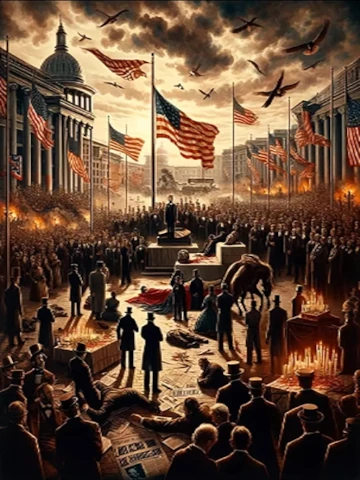
The assassination of Abraham Lincoln in 1865 was a tragic and significant moment in the history of the United States. Just a few days after the end of the Civil War, this event deeply upset the still fragile and rebuilding nation. This article explores the historical context surrounding this tragedy and the immediate impacts that have resulted.
Background to the assassination of Abraham Lincoln
In April 1865, the Civil War came to an end with the surrender of the Confederate forces. Abraham Lincoln, President of the United States since 1861, had led the country through this bloody conflict and worked for the abolition of slavery, notably with the Proclamation of Emancipation and the adoption of the 13th Amendment. However, his vision of rapid reconciliation between the North and the South was not unanimous, particularly among the former Confederates and some radical supporters. It was in this climate of political and social tensions that John Wilkes Booth, a fervent Southern sympathizer, took the decision to assassinate Lincoln, hoping to revive the Southern cause. On 14 April 1865, during a performance at the Fords Theatre in Washington, D.C., Booth shot the president, who succumbed to his injury the next day.
The immediate consequences after President Lincoln's death
The death of Abraham Lincoln caused shock all over the country. The nation, already bruised by years of war, was plunged into deep mourning. Vice-President Andrew Johnson quickly took over the presidency, but he inherited an immense task: managing the reconstruction of a divided country while facing shocking public opinion and still strong tensions. Politically, the assassination strengthened the determination of the Unionists to impose a severe reconstruction in the former Confederate states. In addition, the tracking of John Wilkes Booth and his accomplices mobilized the authorities, and several of them were arrested and executed. This assassination was a lasting mark of American collective memory and highlighted the fragility of the young nation facing political violence.
The assassination of Abraham Lincoln remains a key event in American history, symbolizing both the end of an era and the beginning of a complex reconstruction period. The loss of President Lincoln was a national tragedy that shaped the trajectory of the United States in the years that followed, recalling how fragile peace and unity are in a country marked by war and division.