


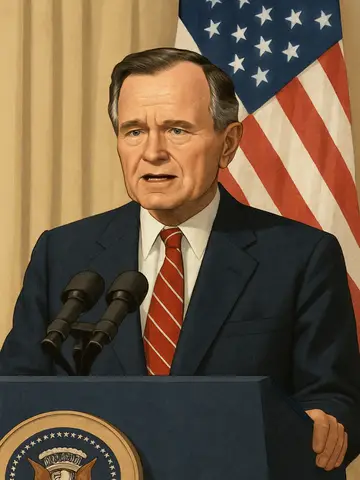
The 1988 presidential election marked an important turning point in American political history with George H. W. Bush coming to power. Former vice-president under Ronald Reagan, Bush was able to capitalize on his predecessor's legacy while bringing his own vision to the White House. His accession to the presidency in January 1989 raised great expectations both at national and international level.
The presidential election of George H. W. Bush in 1989
George H. W. Bush won the 1988 presidential election by beating his democratic opponent Michael Dukakis. His campaign focused on the continuity of Reagan's policies, including national security and economics. Bush was able to convince voters with his image as an experienced stateman, with decades of political career, including key positions such as ambassador to the United Nations and director of the CIA. His victory, with a comfortable majority at the Electoral College, confirmed the confidence of the Americans in the moderate and pragmatic right.
Bush's first landmark decisions
As soon as George H. W. Bush took office in 1989, he made several crucial decisions that defined his style of governance. At the international level, he handled with diplomacy the fall of the Berlin Wall and the end of the Cold War, taking a cautious approach to the Soviet Union. At the domestic level, it has addressed economic challenges, including by attempting to reduce the federal deficit, although some measures, such as tax increases, have been controversial within its own party. These actions have demonstrated its willingness to balance political realism with fiscal responsibility.
The election of George H. W. Bush in 1989 and his first decisions as president profoundly marked the transition from a post-Cold War America to a new era. His mandate laid the foundation for thoughtful diplomacy and stability-oriented governance, traits that will continue to influence US policy in the years to come.