


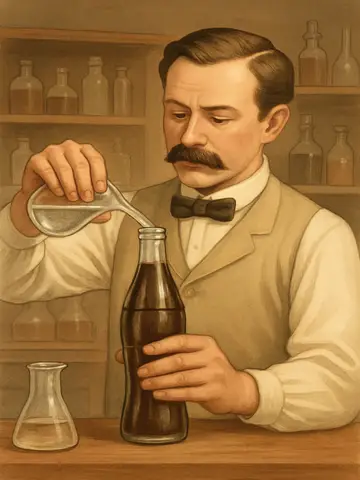
In 1886, in a context of rapid industrialization in the United States and the rise of pharmaceutical innovations, a drink was born that would be a lasting mark of the world's culture: Coca-Cola. His invention is part of a period when traditional medicine and home remedies coexisted with the first mass industries. This creation reflects both the scientific advances of the time and the American economic and social changes.
Historical context and birth of drink in 1886
In 1886, in Atlanta, pharmacist John Stith Pemberton developed an original formula to treat headaches and exhaustion. Initially, Coca-Cola is sold as a « Tonic » in his pharmacy, combining extract of coca leaves and kola nuts. This invention came after the Civil War and at a time when the United States was experiencing rapid urbanization and industrial growth, encouraging the creation of new consumer products. The drink is first offered in a soda fountain, a commercial novelty that attracts urban customers looking for innovative refreshments.
Innovation and dissemination of Coca-Cola in the United States and around the world
Coca-Cola's commercial success was intimately linked to an innovative marketing strategy for the time, including print advertising and the use of specific bottles since the 1890s. Asa Candler, an entrepreneur, acquired the formula in 1888 and transformed the beverage into a consumer product, spreading the brand throughout the United States and then internationally. This boom accompanies the industrialization and standardization of food products, symbolizing the rise of American culture. Coca-Cola became a vector of cultural globalization in the 20th century, linked to major events such as the Universal Exhibition of 1893, the Second World War, where drinking was widely popularized among American soldiers, and the culture of mass consumption after the Second World War.
The creation of Coca-Cola in 1886 illustrates the interconnection between scientific innovation, economic transformation and cultural diffusion in the modern era. This product, born in a specific context, has shaped consumption patterns and a global imagination, emphasizing the power of commercial strategies in contemporary history.