

The beginning of the Vichy regime in 1940 marked a dark and complex stage in the history of France. Following the military debacle in the face of Nazi Germany, this new government, led by Marshal Pétain, established an authoritarian regime that profoundly upsets the foundations of the French Republic. This pivotal moment reflects both defeat, collaboration and political reorganization under the shadow of German occupation.
Historical context of the beginning of the Vichy regime
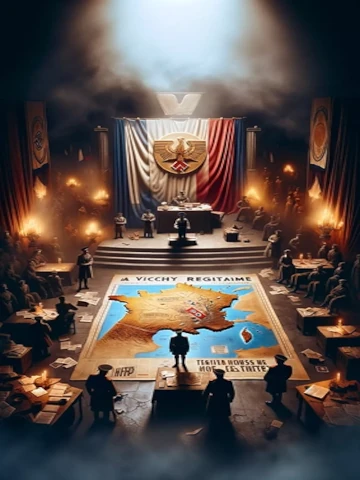
The summer of 1940 was marked by the rapid defeat of France against the German army in the Second World War. After the evacuation of Dunkirk, the French government finds itself in a position of extreme weakness. Paris was occupied, and the government, led by Paul Reynaud, resigned in favour of Marshal Philippe Pétain, hero of the First World War. On 10 July 1940, the National Assembly voted full powers in Pétain, allowing it to put an end to the Third Republic and establish an authoritarian regime based in Vichy, a city known for its thermal springs, but soon symbolizing a divided and submissive France.
First measures and consolidation of power
The Vichy regime quickly embarked on a policy of collaboration with Nazi Germany while seeking to reorganize French society according to a conservative and nationalist ideology. Pétain sets up« French State » which rejects republican values of freedom, equality and fraternity, in favour of a new motto: « Work, Family, Homeland ». The regime instituted authoritarian laws, controlled the press, persecuted political opponents and began to apply anti-Semitic measures, notably through the status of Jews established in October 1940. This consolidation of power is also based on the creation of new institutions and the repression of resistance, thus marking the beginning of a policy of active collaboration with the German occupant.
The beginning of the Vichy regime in 1940 was a key moment in French history, symbolizing a deep rupture with the Republic and a period of suffering and compromise. If armistice and collaboration were justified by some as a necessity in the face of defeat, they left a lasting imprint in collective memory. The Vichy regime thus embodies both the trauma of defeat and the controversial choices of a country caught between occupation and resistance.