

The conquest of the Inca Empire in 1532 is a major episode in the history of the Americas, marking the explosive encounter between two radically different worlds. This event, led by Spanish conquistador Francisco Pizarro, upset the Inca civilization, one of the most advanced in South America. Understanding the beginnings of this conquest as well as the circumstances of the fall of the Inca Empire makes it possible to better grasp the magnitude of this historical transformation.
The first fruits of the Spanish conquest in Peru
Before the arrival of the Spaniards, the Inca Empire was at its peak, extending over a large part of the west coast of South America. However, the territory was weakened by a civil war between two rival brothers, Atahualpa and Huáscar, who disputed the throne. This internal division weakened the political and military cohesion of the Empire, making the empire more vulnerable to invaders. Moreover, the rich and powerfully armed Spaniards had already conquered other parts of America, encouraging them to continue their expansion. The arrival of Pizarro in 1532, taking advantage of the internal tensions and technological superiority of his troops, laid the foundations for conquest.
The fall of the Inca Empire against Pizarro
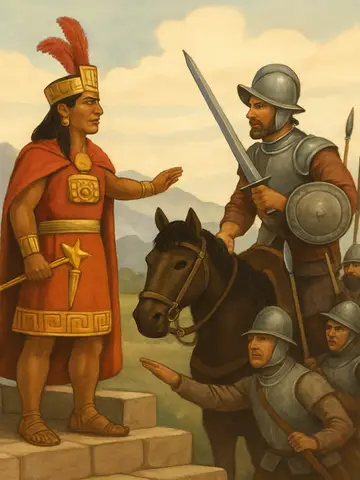
The fall of the Inca Empire was spectacular and rapid. After capturing Atahualpa in the famous battle of Cajamarca, Pizarro used the strategy of ruse and terror to destabilize the Inca resistance. Despite the Incas' fierce will to defend their empire, the superiority of firearms, horses and alliances with some local peoples played a decisive role. The death of Atahualpa in 1533 marked the end of central inca power and triggered a gradual political collapse. From then on, the Empire was gradually integrated into the vice-kingdom of Peru, opening a long period of Spanish colonial rule.
The conquest of the Inca Empire in 1532 by Francisco Pizarro was not only a military victory, but the beginning of a profound transformation of South American societies. It symbolizes the clash between two worlds, Europeans and indigenous peoples, with lasting cultural, political and social consequences. To study this conquest is to understand how a powerful empire can be overthrown by forces from elsewhere, thus drawing a new chapter in world history.