

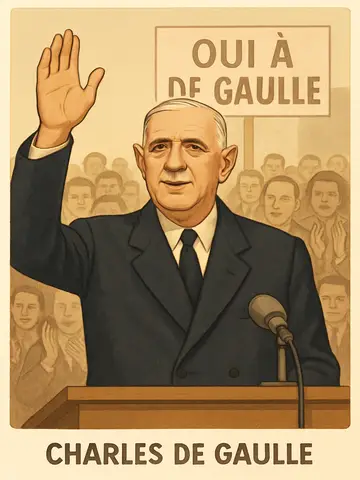
Charles de Gaulle's re-election as President of the Republic in 1965 was a key moment in French political history. This election confirms the major role he intends to play in the Fifth Republic, as well as the consolidation of his political project. A review of this presidential election and the stakes of this second term.
The re-election of Charles de Gaulle in 1965
In 1965 Charles de Gaulle ran for a second term as President of the Republic in the first direct universal suffrage presidential election under the Fifth Republic. This highly anticipated election highlights De Gaulle's popularity despite a political opposition that is organised around several candidates. The election took place in two rounds: De Gaulle faced François Mitterrand in the final. His victory, gained with a relative majority in the first round and confirmed in the second, illustrates the confidence of a large part of the French in his leadership. This electoral success also reflects the gradual anchoring of the Gaullist regime and the new legitimacy conferred on the President by universal suffrage.
A second important term for the Fifth Republic
Charles de Gaulle's second term, beginning in 1965, was marked by major domestic and international challenges. At the national level, it must face a changing society, growing social demands and more structured political opposition. On the international scene, De Gaulle continues his policy of national independence, affirming the greatness of France, notably through the pursuit of nuclear policy and the taking of distance from the American and Soviet superpowers. This second quinquennium is thus emblematic of the Gaullist ambition to modernise France while maintaining an affirmed sovereignty. It also prepares the institutional and economic changes that will shape the Fifth Republic in a sustainable manner.
Charles de Gaulle's re-election in 1965 confirmed the central role he intended to play in French politics. Its second mandate, rich in challenges and strategic decisions, is a decisive step for the consolidation of the Fifth Republic and the modernization of France. De Gaulle thus leaves a lasting imprint on the country, deeply marking its contemporary history.