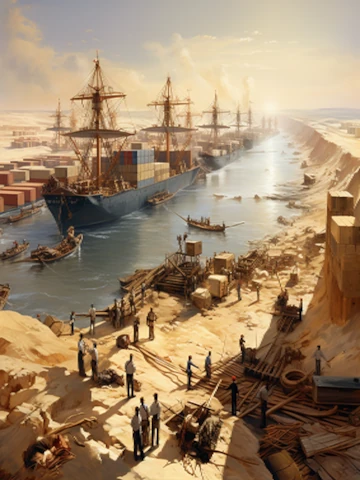


At the beginning of the seventeenth century, Venice retained its role as a major trade hub between the East and the West. The Republic of Venice, independent and governed by an elected dog, ensures the prosperity of the city through maritime trade and strategic alliances. At the political level, Venice must cope with the rise of the Ottoman Empire and the growing rivalry with European powers. In this context of openness to trade and innovation, coffee is emerging.
Historical and political context of Venice at the beginning of the seventeenth century
Venice is then a commercial and maritime power, with a stable oligarchic state. The city is the main entry point in Europe for exotic products from the East, including spices and coffee, a beverage still unknown on the continent. This period is marked by relative political stability, despite the Ottoman threat. Venice takes advantage of its commercial network to import new goods that gradually change consumption habits.
Introduction of coffee in Venice in 1615: actors and immediate consequences
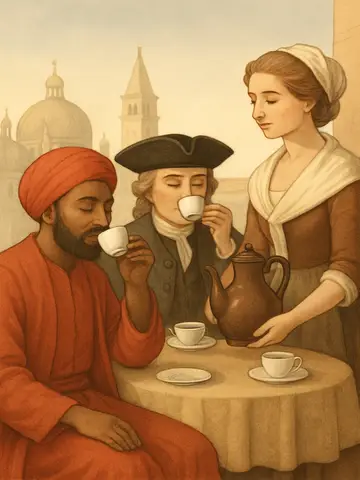
In 1615, a Venetian merchant introduced coffee in Venice, opening the first « coffee » in Europe, a place both commercial and social. This innovation is made possible by commercial relations with the Ottoman Empire, where coffee is already popular. Cafes become a meeting place between intellectuals, traders and artists, stimulating urban life and the dissemination of new ideas. The importation of coffee transforms social habits by introducing a new drink stimulating mental awakening and sociability.
Issues and impacts
The arrival of coffee profoundly alters the Venetian and European society: it contributes to the rise of coffees as public spaces for intellectual exchanges, promoting the appearance of the Enlightenment. Economically, it stimulates trade with the East and encourages coffee cultivation in European colonies. Politically, these places become spaces for discussion, sometimes critical of the regimes in place, participating in the evolution of mentalities. This innovation illustrates the link between trade, culture and communication at the dawn of the modern era.
Historical links
The introduction of coffee in Venice in 1615 was linked to the Ottoman conquest of Constantinople in 1453, which favoured East-West trade. It precedes the rise of cafes in Paris in the 17th century, where they play a similar role in the public debate. Finally, it is part of the European expansion of world trade, illustrated by the opening of maritime routes to India and America, which is transforming Western societies in a sustainable way by the introduction of exotic products.