


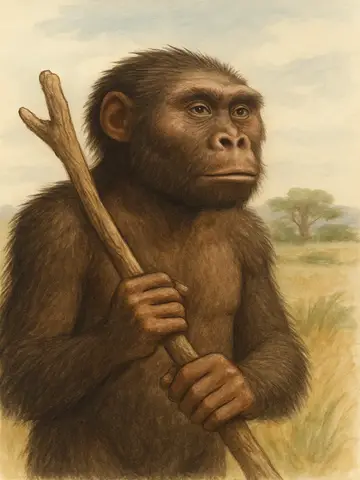
The appearance of the genus Parathropus, about 2.7 million years ago, marks a major step in the evolution of hominids in East Africa. This emergence is part of a geological context characterized by deep climate and environmental change, which shaped the diversity and specialization of the early hominids.
Geological context and early evolution of the genus Parathropus
Around -2.7 million years ago, the Rift Valley region of East Africa is undergoing major environmental transformations with a drier climate and the expansion of savannahs. These changes encourage the diversification of hominids adapted to various ecological niches. Parathropus then appears as a distinct genus, with robust morphological features, including a powerful jaw and large teeth, adapted to a specialized diet. This early evolution is part of a dynamic in which several hominids coexist, including the first representatives of the genus Homo, highlighting a crucial phase of human evolutionary radiation.
Discovery and importance of Paranthropus at -2.7 million years
The discovery of Paranthropus fossils, dating back about 2.7 million years, provided a better understanding of the functional and ecological adaptations of hominidae at that time. Parathropus is significant for its role in evolutionary diversification parallel to Homo. This genre illustrates a distinct adaptive strategy centered on a robust diet, contrasting with Homo's growing cognitive and technical capabilities. The cohabitation of these lines shows a major evolutionary complexity. This appearance precedes key events such as the development of more sophisticated lithic tools by Homo habilis, as well as the progressive evolution towards Homo erectus.
The emergence of the genus Parathropus at -2.7 million years provides an essential overview of the environmental and evolutionary pressures that have shaped the diversity of hominids. His study enriches the understanding of prehistoric evolutionary mosaic and complex interactions between contemporary species in the African cradle of humanity.