

Origins and historical context of Backgammon circa -3000
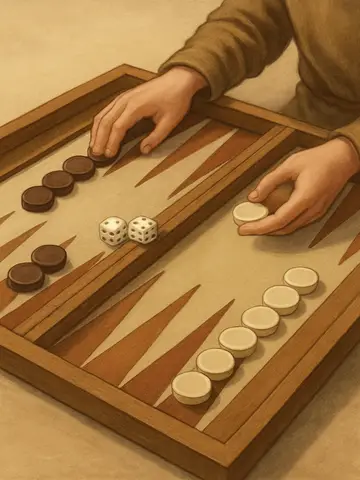
Around 3000 Mesopotamia, a region between the Tigris and the Euphrates, is undergoing advanced urbanization marked by the emergence of the first cities-states like Uruk and Ur. It is in this context of political and social development that the beginnings of the Backgammon are born, a game of society resulting from an evolution of games of chance and strategy used by priests and elites for entertainment and sometimes divination. Plates and pawns discovered at archaeological sites, especially in modern Iraq, testify to the existence of games similar to the Backgammon, called later « Royal d'Ur game ». These games reflect a hierarchical society where the free time of the ruling classes promotes the creation of codified intellectual activities.
Cultural role and evolution of Backgammon in ancient times
The primitive Backgammon is part of the fun and ritual tradition of ancient civilizations, especially Sumerian and Babylonian. Its use goes beyond mere entertainment, integrating religious and social dimensions, with codified rules that are transmitted orally or by inscription. Over the centuries, the game evolves and spreads to Egypt, Persia and Greece, where it becomes a tool for social interaction between elites. Its mechanics of chance and strategy reflect ancient conceptions of destiny and luck, in connection with the religious beliefs of the time. Backgammon subsequently influences other board games and participates in the formation of a shared playful culture in the Mediterranean, parallel to the appearance of Athenian democracy or Mediterranean empires, demonstrating cultural continuity between ancient and classical civilizations.