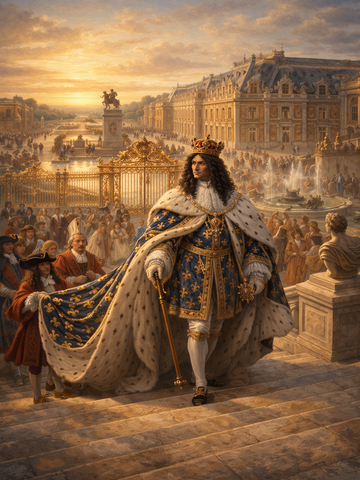


The death of Louis XIV in 1715 marks the end of a major era in the history of France and Europe. Nicknamed the Sun King, he reigned for more than 72 years, leaving behind him a deeply transformed kingdom. This event is not only the end of a life, but also the end of a reign that has shaped the absolute monarchy and French political identity. An analysis of Louis XIV's last moments and the consequences of his death provides a better understanding of the issues that France faced in the early 18th century.
The end of a reign: Louis XIV facing death in 1715
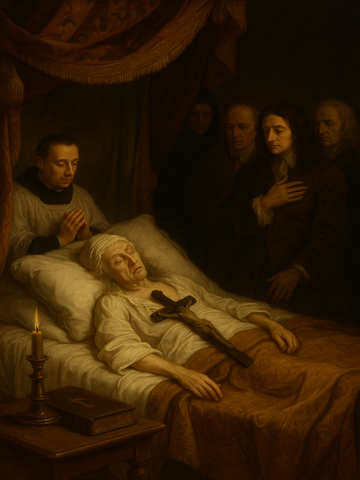
In September 1715, the Sun King, weakened by many diseases, faced the inevitable end of his life. For several years, her health had deteriorated, mainly due to gangrene and other complications related to her advanced age. Despite this, Louis XIV remained until the end a monarch concerned with his image and the greatness of his kingdom. His close entourage observed with concern the sovereign's decline, aware that his departure would plunge France into a period of uncertainty.
During his last days, Louis XIV showed a fierce will, settling his state affairs with almost ritual precision. His will, revised several times, was designed to ensure the stability of the monarchy and to protect its descendants. He surrounded his relatives, including his great-grandson, the future Louis XV, still a child, and the regent who took over at his death. This solemn moment is both a personal farewell and a major political act.
When the king died on September 1, 1715, it was a shock to the court and to the whole kingdom. France loses a symbol of undisputed power and authority. The disappearance of the Sun King marks the end of an exceptional reign by its longevity and intensity, rich in wars, building palaces, and centralizing power. Louis XIV left behind a legacy as imposing as it was complex, which would condition France for decades to come.
Political consequences after the death of Sun King
The death of Louis XIV immediately led to a delicate transition to the top of the state. His great-grandson, Louis XV, was only five years old when he joined the throne. Consequently, a regency is instituted, entrusted to Philip d'Orléans, who must rule until the young king reaches his majority. This period of regency is marked by many political challenges, including tensions between different factions of the court, eager to influence power.
At the institutional level, the absolute reign of Louis XIV left a contradictory legacy. On the one hand, the monarchy retains its prestige and authority, but on the other hand, finances are exsangued after decades of costly wars. The administration of the kingdom then becomes a priority for the regency, which must restore economic balance while maintaining inner peace. This period also opened discussions on the nature of royal power and the limits of absolutism.
Finally, the death of Louis XIV has a strong symbolic significance in European history. His reign had made France the continent's first power, and his departure left a void that other states were seeking to fill. Diplomacy and alliances are adjusting, paving the way for future conflicts. Thus, 1715 means not only the end of a monarch, but the beginning of a new political era in which France must redefine its place in a changing world.
La disparition de Louis XIV en 1715 est un moment charnière qui résonne bien au-delà de la mort d’un souverain. Elle clôt un règne unique par sa durée et son impact sur la monarchie française et européenne. Les suites immédiates de cette perte ouvrent une période de transition, marquée par l’instauration de la régence et les nombreux défis qui l’accompagnent. En regardant ce tournant historique, on mesure combien le Roi-Soleil a façonné son temps et combien son héritage a continué à influencer la France pour les décennies à venir.