


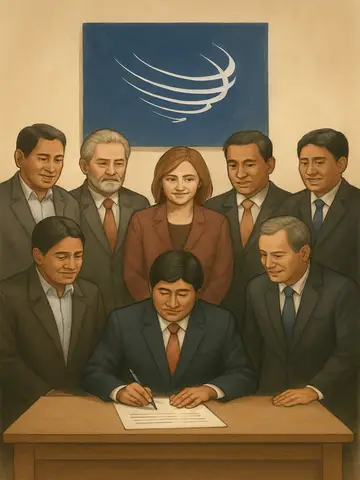
The Union of South American Nations (UNASUR) was established in 2004 in a regional context marked by common economic, social and political challenges. This organization was born out of the desire of the South American countries to strengthen their integration and promote harmonious development, while affirming their autonomy on the international stage. The creation of UNASUR represents a crucial step in the contemporary history of South America, aimed at uniting the efforts of member States to meet together the challenges of the twenty-first century.
Background to the creation of UNASUR in 2004
In the early 2000s, South America faced crucial challenges, including the need to overcome the aftermath of the economic crises of the 1990s, persistent poverty and political instability in several countries. Moreover, the region sought to assert itself more on the international stage, often dominated by the great powers. It was in this context that South American leaders felt the need to create a strong and integrated regional organization capable of fostering political, economic and social cooperation. The UNASUR was thus formalized in 2004, bringing together twelve countries in the region around a common vision of unity and progress.
UNASUR's main objectives and challenges from its inception
From its inception, UNASUR has set itself the main objective of strengthening regional integration by promoting the coordination of economic, social and environmental policies among its members. The organization also aims to ensure peace and security on the continent by establishing mechanisms for political dialogue and peaceful conflict resolution. Among the major challenges was the desire to reduce dependence on the major external powers and to build an autonomous area of cooperation on a South American scale. In this way, UNASUR sought to create a strong institutional framework to improve connectivity, facilitate intra-regional trade and defend the common interests of member nations.
The creation of UNASUR in 2004 marked a historic turning point for South America, symbolizing the hope of a more united and supportive region in the face of global challenges. Although the organisation has experienced difficulties and developments since its founding, it remains an important example of regional political will to build a shared future. In this way, UNASUR embodies the quest for an affirmed South American identity, brought about by cooperation and solidarity among the peoples of this vast region.