


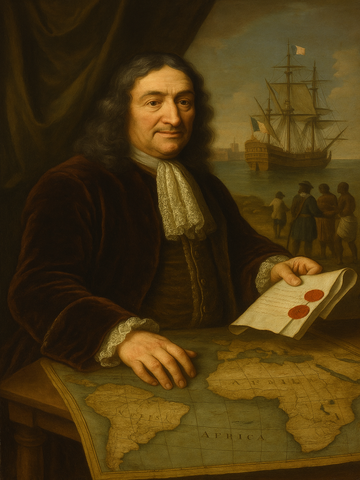
The creation, in 1664, of the Compagnie française des Indes — often called the East Indies Company — is part of the great mercantilist movement of the seventeenth century. Under the leadership of Jean-Baptiste Colbert and with the support of King Louis XIV, France sought to compete with the maritime powers of northern Europe and to participate directly in the lucrative trade with Asia. For students, understanding this foundation, its objectives and its consequences allows us to approach the notions of commercial monopoly, emerging imperialism and colonial rivalries that shaped the modern world.
Fondation de la Compagnie française des Indes, 1664
The Company was founded in 1664 on the initiative of Jean-Baptiste Colbert, Minister of Louis XIV, who wanted to give France a structure capable of exploiting the wealth of Asia and competing with the Dutch and English Companies. The Crown granted the new company important privileges: trading rights, ability to arm ships and establish counters. These privileges were part of the Mercantist doctrine, according to which a State must accumulate precious metals and wealth through controlled foreign trade.
From the beginning, the Company organized expeditions to the Indian Ocean and South-East Asia: in India, it founded and developed counters such as Pondicherry, Chandernagor, Mahé and Karikal; In the Indian Ocean it was also interested in the Mascareignes (Île de France/Maurice, Île Bourbon/Reunion). These establishments served as both supply points, warehouses for goods and bases to protect merchant ships.
The company's establishment was not only economic: it involved private capital, investors and administrative executives sent by the metropolis. The first years mixed hopes for profit, logistical difficulties and rivalries with the already established powers. For students, this is a concrete example of how political decisions in Paris translated into concrete actions on other continents.
Economic and Political Role of the Company in Asia
Economically, the Company played a central role in the import and distribution of high demand Asian products in Europe: spices, silks, Indian cottonnades, tea, porcelain and other luxuries. By establishing regular counters and shipping routes, it facilitated the movement of these goods to French and European ports. The Company also participated, like other actors of the time, in darker trafficking such as the slave trade, which fueled Atlantic colonies and trade.
Politically and militarily, the Company did not limit itself to trade: it built forts, lifted militias, signed treaties and made alliances with local sovereigns to secure its interests. Her ships could be armed and, during wartime, she was engaged in naval or private operations against enemy ships. These activities gave him real diplomatic and territorial influence, contributing to the French settlement in India and the Indian Ocean.
However, the Company had to face strong constraints: English and Dutch competition, intercolonial wars, financial problems and sometimes mismanagement weakened its effectiveness. In the long term, these difficulties, combined with the expansion of rivals such as the British East India Company, limited the extension and sustainability of the French commercial empire in Asia. For students, this episode illustrates how economics, politics and war intersect in colonial history.
The Compagnie française des Indes, founded in 1664, is a good entry point to study the colonial period: it shows how the state and private capital have joined forces to conquer distant markets, how trade has been a driving force for diplomacy and conflict, and how these dynamics have shaped territories far beyond the European coasts. Understanding its history helps to grasp the origins of French settlements in Asia and the consequences of colonial competition in the 17th and 18th centuries.