

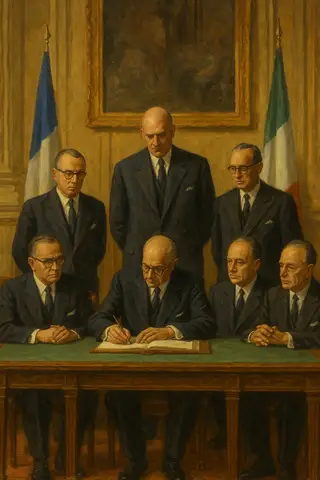
The Treaty of Rome, signed in 1957, represents a crucial step in the construction of modern Europe. This founding text marks the birth of the European Economic Community (EEC), laying the foundations for deeper economic integration between several European countries. Understanding the historical context as well as the objectives and impacts of this treaty allows us to better understand its importance in the political and economic development of the continent.
Historical context of the Treaty of Rome in 1957
In the post-war period, Europe sought to rebuild itself and avoid further devastating conflicts. The Second World War left the European nations fragile, both economically and politically. It was in this climate that European leaders wanted to establish closer cooperation to ensure peace and prosperity. After the success of the European Coal and Steel Community (ECSC) in 1951, the Treaty of Rome was signed by six countries – Belgium, France, Italy, Luxembourg, the Netherlands and West Germany – to establish a common market and strengthen economic ties. This post-war context, marked by a desire for stability and unity, has led to the birth of this historic treaty.
Main objectives and impacts of the Treaty of Rome
The main objective of the Treaty of Rome was to create a common European market, removing customs barriers between Member States and facilitating the free movement of persons, goods, services and capital. It also aimed to harmonize economic policies to stimulate growth and improve the standard of living of citizens. The impact of this Treaty was considerable: it laid the foundations for what would later become the European Union, promoting progressive economic and political integration. Through the Treaty, member countries have been able to strengthen their cooperation, increase their economic weight on the world stage and promote sustainable peace in Europe. It remains a strong symbol of the European will to unite their forces in the face of common challenges.
The 1957 Treaty of Rome is much more than just an economic agreement; It is the pillar on which modern Europe has been built. By laying the foundations for close cooperation between member countries, it has transformed a divisive continent into a dynamic and integrated community. More than six decades after its signing, the Treaty legacy continues to influence European politics and the economy, recalling the importance of solidarity and collective work to build a common future.