

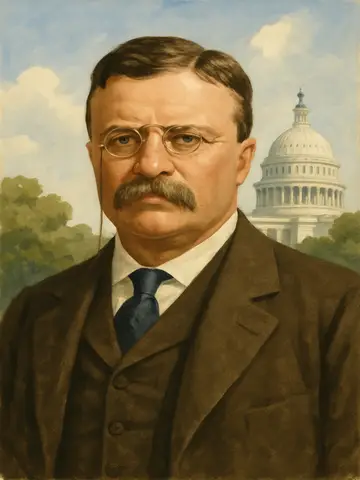
The year 1901 marks a major turning point in the political history of the United States with the arrival in power of Theodore Roosevelt. Named « Teddy »Roosevelt became president in dramatic circumstances, after the assassination of William McKinley. This sudden takeover led to a period of intense transition in which Roosevelt had to quickly establish his authority and define a new direction for the country.
Theodore Roosevelt: his arrival in the presidency in 1901
On 14 September 1901, following the assassination of President William McKinley, then Vice-President Theodore Roosevelt was officially invested as 26th President of the United States. Roosevelt, known for his overflowing energy and fiery temperament, became the youngest president in American history at only 42 years old. His unexpected ascension surprised many observers, but he immediately imposed his direct style and progressive vision, inherited from his past as governor of New York and leader in the reform movement. His arrival at the White House symbolized a wind of political renewal and a strong commitment to social justice and economic regulation.
Roosevelt's first challenges after his inauguration
From the beginning of his term, Roosevelt faced several major challenges. The issue of the consolidation of presidential power has become an issue, particularly in the face of large companies and trusts, whose disproportionate influence on the economy and politics he wanted to limit. It has thus initiated bold antitrust procedures to protect competition. Moreover, Roosevelt quickly became involved in social issues, advocating reforms to improve working conditions and protect the environment, as evidenced by its policy of conservation of natural resources. Finally, it has had to manage the expectations of a country that is expanding industrially, while maintaining national cohesion after a troubled period, which has strengthened its reputation as a vigorous and innovative leader.
The year 1901 was the beginning of a new era with Theodore Roosevelt in power, a president who marked his time with his dynamism and strong commitments. His sudden accession to the presidency placed him in the face of heavy responsibilities which he assumed with courage and determination. Roosevelt was able to turn these challenges into opportunities, laying the foundations for a political modernism that would profoundly influence the 20th century.