


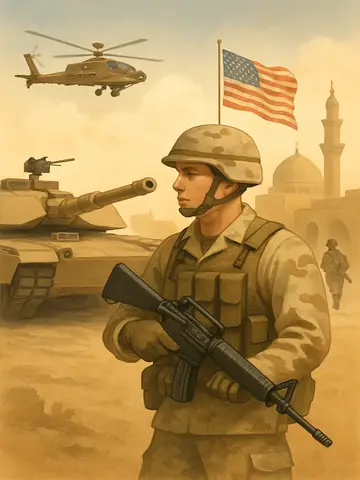
The Second Gulf War, also known as the invasion of Iraq in 2003, represents a major episode of the early 21st century, marked by an international military intervention orchestrated mainly by the United States and its allies. This conflict has profoundly affected the Middle East region and has had a lasting impact on global policy. Understanding the causes, actors involved and the course of this war is essential to grasp its strategic and human implications.
Causes and outbreak of the Second Gulf War in 2003
The causes of the Second Gulf War are complex and multifactorial. Officially, the United States and its allies justified Iraq's invasion by the need to destroy the weapons of mass destruction (WMD) allegedly possessed by Saddam Hussein's regime, as well as by the fight against terrorism after the attacks of 11 September 2001. In addition, geopolitical considerations, such as the control of Iraqi oil resources and the willingness to reshape the region by eliminating a regime deemed dictatorial and dangerous, have also played a crucial role. In March 2003, after several months of intense diplomatic pressure and the exhaustion of United Nations inspections, the United States-led coalition launched a major military offensive that marked the official beginning of the conflict.
Main actors and developments in the military conflict
The main actors in the Second Gulf War were the United States-led international coalition with British, Australian, Polish and other partner countries. On the other hand, the Iraqi army loyal to Saddam Hussein quickly found itself overwhelmed by the technological and tactical superiority of the invader. The conflict started with an intensive air campaign followed by a rapid land invasion, leading to the fall of Baghdad in April 2003. However, the war did not stop there: it turned into a prolonged insurgency with urban fighting, terrorist attacks and a difficult occupation that lasted several years, plunged Iraq into lasting political and social instability.
The Second Gulf War of 2003 left a deep mark on Iraq and the world. While the invasion led to the overthrow of Saddam Hussein's regime, it also paved the way for a period of violence, instability and internal divisions that continue to affect the region. This conflict has raised many questions about the legitimacy of military interventions, the management of the post-war period and the long-term consequences of international strategic decisions. His study remains essential to draw lessons on the complexity of modern conflicts.