

The Russian Revolution of 1917 was a major event that upset not only Russia, but also the course of world history. It marks the end of the Tsarist regime and the advent of a communist regime that will profoundly influence the twentieth century. To understand this revolution, it is essential to examine the root causes that led to the uprising of the Russian people, as well as the key events that characterized this crucial year.
The root causes of the Russian Revolution of 1917
The Russian Revolution is rooted in a combination of economic, social and political factors. Imperial Russia was then a deeply unequal society, dominated by a privileged nobility and an autocratic tsar, Nicholas II, disconnected from the needs of the people. The archaic agriculture, the poverty of the peasants and the deplorable conditions of the working class in the cities created fertile land for protest. On the other hand, Russia's disastrous participation in the First World War aggravated the economic and social crisis: food shortages, massive loss of life and widespread discontent reinforced the distrust of the regime. Finally, the lack of political reforms and the repression of social movements fueled popular anger, thus paving the way for the revolution.
Key Events of 1917
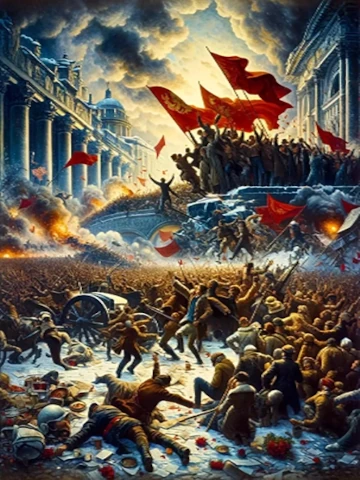
The year 1917 was marked by two major revolutions. The first, in February (according to the Russian Julian calendar), saw the overthrow of the Tsar Nicholas II after massive demonstrations in Petrograd, triggered by hunger and exhaustion due to the war. The power then passed to a provisional government, dominated by moderate liberals and socialists, which nevertheless kept Russia in the global conflict. This unsatisfactory situation allowed the Bolsheviks, led by Lenin, to gain influence. In October, they organized a coup d'état known as the October Revolution, taking control of key institutions and establishing a communist regime. This radical change ended the old order and gave rise to the Soviet Union, marking a decisive turning point in world political history.
The Russian Revolution of 1917 remains a fundamental moment in history, symbolizing the end of one era and the beginning of another, based on radically new ideals. It is the result of deep social and political discontent accumulated over decades, exacerbated by the horrors of the First World War. Its impact has been global, inspiring revolutionary movements everywhere and redefining international power relations for the next century. Understanding this revolution means grasping the complex dynamics that can lead to a major change in a society.