

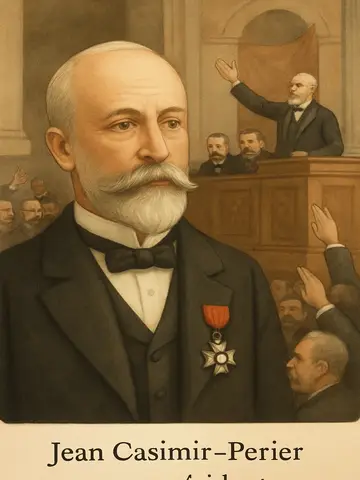
Jean Casimir-Perier is a French political figure whose name remains associated with a particularly tumultuous period of the Third Republic. Elected President of the Republic in 1894, his accession to power took place within a busy political context and reflected the tensions of an era marked by political scandals and rivalries. Return to this election and to a brief but intense term.
The election of Jean Casimir-Perier as president in 1894
Jean Casimir-Perier was elected president of the French Republic in 1894, succeeding Sadi Carnot, who was murdered that same year. Born into a well-known political family, he has a solid background, having already been President of the Council and Minister. His election comes in a climate of crisis, notably because of the Panama case, which has shaken confidence in the institutions. His moderate profile and political past convinced the National Assembly to entrust him with the presidency, in the hope that he could restore the authority and stability of the government.
A brief mandate but marked by major political challenges
Jean Casimir-Perier's term as president was considerably short, since he resigned as early as 1895, after only six months in office. This decision surprised his contemporaries and was explained by persistent tensions with Parliament and ministers, which limited his role to an essentially honorary office. Moreover, France was experiencing major crises, such as the beginnings of the Dreyfus Affair, which deeply divided public opinion and complicated the President's task. Unable to assert itself fully in this context, Casimir-Perier chose to withdraw, highlighting the limits of presidential power under the Third Republic.
Jean Casimir-Perier remains an emblematic figure of the Third Republic, not both in terms of the duration of his term of office and the difficult circumstances which marked his transition to the Elysée. His election in 1894 reflected the political challenges of the time, while his resignation highlighted the difficulties faced by the presidents in the face of rigid parliamentaryism. A brief but informative episode on the relationship between executive and legislative power in France.