

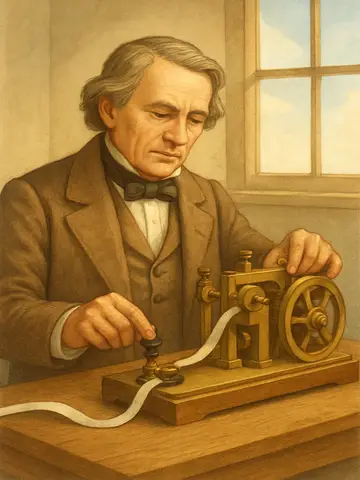
The invention of the telegraph in 1791 marked a major milestone in the history of communications. At a time when messages were still being transported on horseback or by postal mail, the telegraph opened the way for rapid and efficient transmission of information over long distances. This innovation, although primitive compared to modern technologies, has laid the foundation for current communication systems.
The invention of the telegraph in 1791: a revolution
In 1791 Claude Chappe, a French inventor, developed the first optical telegraph, also known as air telegraph. This system used semaphores composed of mobile arms placed on towers, allowing to encode and transmit visual messages from one station to another. This has revolutionized communication by allowing information to be transmitted in a few minutes, where it took several hours or even days before. Chappe's telegraph was quickly adopted by the French administration, notably to coordinate military movements and government affairs.
How the telegraph transformed fast communication
The optical telegraph fundamentally changed the way information circulated across territories. This system has inaugurated the era of almost instant communication, breaking the geographical barriers that have so far slowed down the transmission of messages. It has enabled governments and armies to respond much faster to events, thereby improving strategic decision-making. Moreover, the success of the optical telegraph inspired the further development of the 19th century electric telegraph, which would further accelerate and simplify global communication.
The invention of the telegraph in 1791 by Claude Chappe represents a decisive turning point in the history of communications. This innovative system not only accelerated the transmission of information, but also paved the way for modern communication technologies. By allowing rapid and effective communication, it has helped transform societies and their interactions, illustrating perfectly how an invention can upset the course of history.