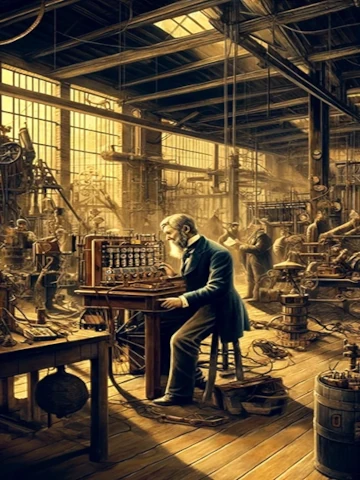
The invention of the telegraph in 1837 marks a revolutionary step in the history of communications. Prior to this major innovation, distance information exchanges were slow and often unreliable. The telegraph was able to transmit messages within minutes, thus upsetting the political, economic and social fields. This article explores the origins of this invention and the central role of Samuel Morse in its development.
Origins and context of telegraph invention
At the beginning of the 19th century, the need to improve communications became increasingly felt, particularly with the growth of commercial networks and public administrations. Before the telegraph, the messages depended mainly on physical mail, which could take days or even weeks. Several scientific experiments had already tried to transmit electrical signals over long distances, but without commercial or practical success. It was in this context of innovation and urgency that the electric telegraph came into being, promising a rapid and reliable transmission of information.
Samuel Morse and the birth of the electric telegraph in 1837
Samuel Morse, an American inventor and painter, is often credited as the father of the electric telegraph. In 1837, he developed a system capable of sending coded signals through an electric wire, using a simple binary code now known as Morse code. This system combines a transmitter and an electromagnetic receiver to translate electrical impulses into legible symbols. His invention was quickly adopted, transforming global communications and paving the way for modern telecommunications technologies.
Samuel Morse's invention of the telegraph in 1837 radically changed the way the world communicates. It has reduced distances by bringing individuals and institutions closer together, thus accelerating economic and social development. More than just a technical tool, the telegraph was the precursor of an era of global connection, whose foundations laid in the 19th century continue to influence our daily life today.