


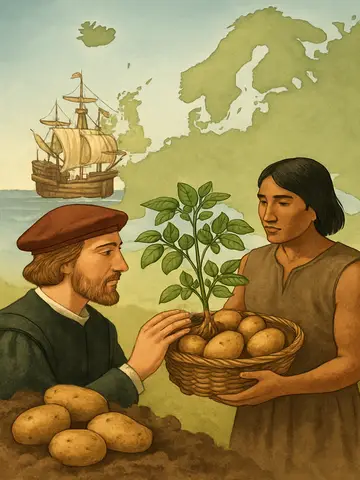
The introduction of the potato in Europe around 1570 marks a major agricultural turning point, part of the great transatlantic discoveries and exchanges that redefine the European economy and society during the Renaissance.
Historical context and initial spread of the potato
The potato, native to the Andes in South America, was discovered by Spanish explorers during the conquests of the 1530s. Its introduction into Europe around 1570 takes place in a context of economic and geopolitical transformations linked to European colonial expansion. The Spaniards, first to report it, present it as a botanical curiosity, first cultivated in the botanical gardens of royal courts and universities, notably in Spain, Italy and France. Its adoption remains slow, marked by initial mistrust related to its exotic roots and membership of the solanaceae family, which is considered toxic.
Agricultural impact and socio-economic change in Europe after 1570
From the 17th century onwards, the gradual spread of potatoes changed agricultural practices in Europe, particularly in regions with poor soils or harsh climates where cereals were less productive. This new crop improves food security, increases yields and provides an abundant calorie source, contributing to population growth. At the socio-economic level, it participates in crop diversification, famine reduction and changes in land tenure. The introduction of the potato is also part of a broader set of rural and economic transformations preceded by triangular trade and followed by the 18th century agricultural revolution.
The introduction of the potato into Europe in 1570, although initially modest, opened a new agricultural era with multiple repercussions. It illustrates the lasting effects of global trade initiated by European expansion and reveals the close links between scientific discovery, agricultural adaptation and deep socio-economic transformation.