


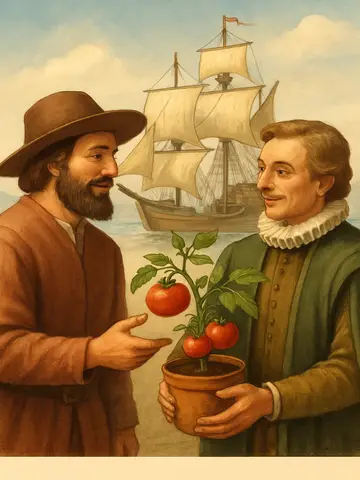
The introduction of tomato in Europe in 1540 marks a major turning point in the continent's agricultural and culinary history, linked to the great transatlantic explorations and exchanges that have redefined food knowledge and resources.
Historical and political context before the introduction of tomato in 1540
At the beginning of the 16th century, Europe was in the middle of the Renaissance, a period of geographical expansion and scientific renewal. The Grandes Découvertes, initiated at the end of the 15th century with the travels of Christopher Columbus (1492) and Vasco de Gama (1498), opened new trade routes between the Old and the New World. European powers, in particular Spain and Portugal, dominate these exchanges and introduce previously unknown plants into Europe, such as maize, potatoes and tomatoes. Politically, the consolidation of the European monarchies promotes the stability necessary for the development of trade and the gradual adoption of these new developments.
Key facts and first impacts of tomato in Europe in the 16th century
The tomato, native to the Andean region of South America, is brought back to Europe around 1540 thanks to Spanish expeditions. First cultivated as an ornamental plant, the tomato arouses suspicion and curiosity because of its botanical family (solanaceae) considered toxic. Gradually, its food use spread in the Mediterranean, especially in Italy, where it became a central ingredient from the seventeenth century. This input feeds a gradual transformation of European diets, although its adoption remains slow in the 16th century.
Issues and impacts
The introduction of tomato contributes to food diversification in Europe, helping to improve nutrition and enrich regional cuisine. Economically, tomato cultivation stimulates local agriculture and seed exchange. Politically, it illustrates Spanish domination over maritime routes and the transfer of colonial knowledge. Culturally, the integration of tomato into European gastronomy heralds the globalization of tastes and products. This event is part of the broader dynamic of Colombian trade, which profoundly alters food and social balances.
Historical links
The introduction of tomato is directly related to the voyages of Christopher Columbus (1492), which pave the way for intercontinental exchanges. It precedes the massive adoption of the potato in Europe in the 17th century, another American tuber fundamental to European demography. Finally, it is part of the continuation of Spanish colonial policies which, throughout the 16th century, enrich Europe with exotic resources, a phenomenon which also favours the development of commercial empires and scientific exploration.
The arrival of tomatoes in Europe in 1540 illustrates the complexity of the global trade initiated by the Great Discoveries, revealing how a simple fruit can become a vector of sustainable cultural, economic and political transformation.