

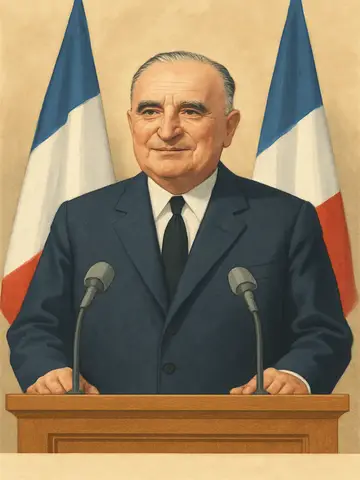
The election of Georges Pompidou as President of the French Republic in 1969 marks a major turning point in France's political history. Following Charles de Gaulle, Pompidou embodies a continuity but also an evolution in the governance of the country. His accession to power comes in a particular context, while France must rebuild itself after the events of May 68 and affirm its place in the modern world.
The election of Georges Pompidou as President in 1969
On 15 June 1969, Georges Pompidou won the presidential election against Alain Poher, obtaining a clear majority in the second round. Former Prime Minister under De Gaulle, Pompidou enjoys the image of a man of consensus and experience. His election was seen as a guarantee of stability after the resignation of General de Gaulle, who had left power following a failed referendum. Pompidou then represents the continuity of the Fifth Republic while bringing a new breath, thanks to his in-depth knowledge of public affairs and his commitment to the modernization of France.
A new start for France under Pompidou
When he came to power, Georges Pompidou set about energizing the French economy while calming the social tensions inherited from the events of 1968. It encourages industrial development, scientific research, and infrastructure expansion, illustrated by projects such as the creation of the Pompidou Centre, dedicated to culture and modernity. At the international level, Pompidou continues the Gaullist policy of national independence, while strengthening European cooperation. Its mandate is thus marked by a balance between tradition and innovation, which prepares France for the challenges of the 21st century.
The election of Georges Pompidou in 1969 and his leadership of the state are a crucial step in French contemporary history. A man of dialogue and projects, he managed to combine Gaullist heritage and modernisation, giving France a new impetus after a period of uncertainty. His presidency leaves a lasting legacy, where politics, culture and economy intertwine to draw the contours of a changing France.