


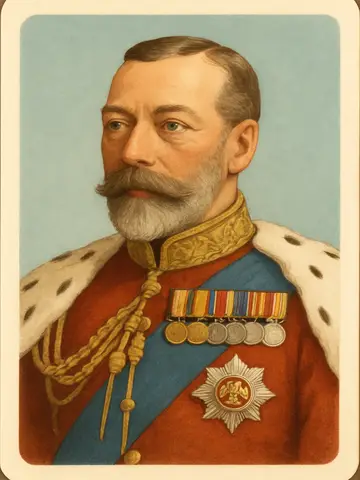
George V, who rose to the throne of the United Kingdom in 1910, is an iconic figure in British history. Its reign marks a period of major transition, both political and social, in which the monarchy must adapt to the upheavals of the twentieth century. Heir to a prestigious royal lineage, George V was able to navigate with caution and determination in a complex international and domestic context.
George V's ascension to the British throne in 1910
George V entered the throne after his father, Edward VII, died in May 1910. Its coronation comes at a time when the United Kingdom is still a dominant global power, but faced with increasing tensions both within and outside its borders. George V, Prince of Wales before his accession, was perceived as a modern sovereign, attached to traditions but aware of the need for reform. His coming to power is greeted with hope by a population that expects stable and reassuring leadership from him. His reign begins under the sign of continuity, in the face of a Europe in full political effervescence.
The first challenges of George V's reign in the United Kingdom
The early years of George V's reign were marked by several major challenges. At the domestic level, it must manage the social tensions exacerbated by rapid industrialisation and the demands of labour movements. Moreover, the question of Ireland's autonomy is becoming a crucial political issue, threatening the unity of the Kingdom. At the international level, the rise of nationalisms and the arms race in Europe herald the imminence of a global conflict. George V also faces the need to modernize the monarchy to maintain its legitimacy in a rapidly changing world. His ability to maintain the balance between tradition and modernity will be decisive for the continuation of his reign.
George V's reign, which began in 1910, is therefore that of a monarch faced with profound and often difficult transformations. Its way of dealing with these initial challenges lays the foundation for a British monarchy capable of going through the crises of the twentieth century. George V thus remains a symbol of stability at the heart of a turbulent era, embodying the continuity of a millennial institution in the face of the demands of modernism.