


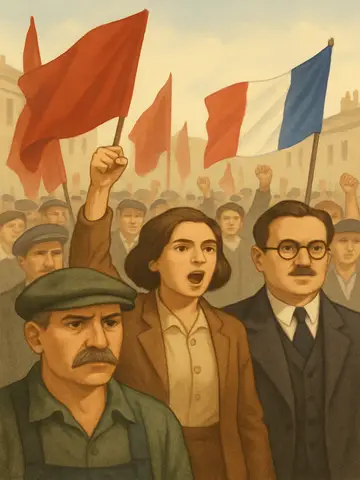
The 1936 Popular Front represents a pivotal period in the political and social history of France. In the face of rising economic and political tensions in Europe, this coalition of left-wing parties has mobilized a large part of the French population around an ambitious programme of social and democratic reforms. A review of the context in which this movement was born and of the major transformations that he initiated.
Historical background and the birth of the Popular Front
In the 1930s, France was experiencing a deep economic crisis linked to the Great World Depression. Unemployment is exploding, living conditions are deteriorating, and the country is also facing the rise of fascist movements in Europe, particularly in Germany and Italy. Faced with these threats, the left-wing parties – socialists (SFIO), communists (PCFs) and radicals – decide to unite in order to defend democracy and bring social solutions to the population. This gathering, called the Popular Front, won a large victory in the parliamentary elections of May 1936, carried by the charismatic figure of Léon Blum, first president of the Socialist Council of the Third Republic.
Major social reforms of 1936 in France
As soon as it came to power, the Popular Front implemented a comprehensive programme of social reforms aimed at improving the condition of workers and revitalizing the French economy. Among the emblematic measures are the Matignon agreements, which introduce wage increases, recognition of trade unions, and the reduction of weekly working hours to 40 hours. Paid leave is also introduced for the first time, thus opening up new rights to workers and employees. These social advances, although sometimes criticized by conservative circles, have profoundly affected French society by laying the foundations for social modernization and strengthening social democracy.
The 1936 Popular Front remains an essential moment in the history of France, symbolizing the union of progressive forces in the face of the crisis and totalitarian threats. Its social reforms have made a lasting difference in the lives of workers and have included in French legislation fundamental rights still recognized today. Beyond concrete progress, this movement also embodies the hope of a more just and supportive society, a legacy that always inspires contemporary struggles.