


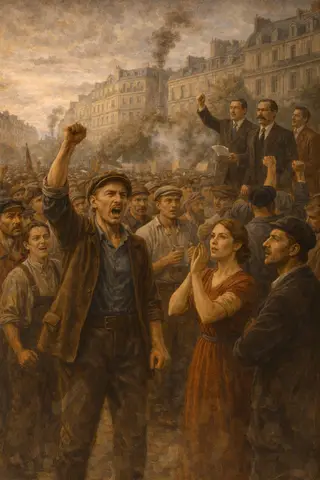
The 1936 Popular Front represents a key moment in French political and social history. Born in a context of global economic crisis and the rise of extremism, this unprecedented gathering of left-wing forces has profoundly marked French society with its ambitious reforms and its commitment to social justice. A review of the origins, formation and achievements of this emblematic movement.
The origins and formation of the Popular Front in 1936
The Popular Front was born of an urgent need to respond to the economic and social crisis that struck France in the mid-1930s, aggravated by the rise of the extreme right-wing leagues and the fascist threat in Europe. Faced with this situation, the main left-wing parties — the SFIO (French Workers' International Section), the French Communist Party (PCF), and the Radical Party — united to form an electoral coalition. This alliance, impulsed notably by Léon Blum, aimed to defend the interests of the popular classes and to prevent the rise of authoritarianism. The Popular Front thus won the parliamentary elections of May 1936 with a significant majority, embodying a hope for profound social change.
Major social reforms of the Popular Front in France
From its entry into power, the Popular Front government, led by Léon Blum, implemented a series of innovative social reforms aimed at improving the living conditions of workers. Among the flagship measures are the introduction of two-week paid leave, a major step forward for the right to rest and leisure. In addition, the working week was reduced to 40 hours, favouring a better distribution of working time. The Popular Front has also encouraged collective bargaining through the recognition of trade unions, which has strengthened the voice of workers. These reforms, although contested, have broken with previous practices and laid the foundation for modern French social policy.
The 1936 Popular Front remains a founding period of French social and political history. Through its unity in the face of external threats and bold social reforms, it has given hope to millions of workers and created fundamental rights still celebrated today. Although his experience was brief, his legacy continued as a symbol of progress and solidarity in the struggle for a more just society.