

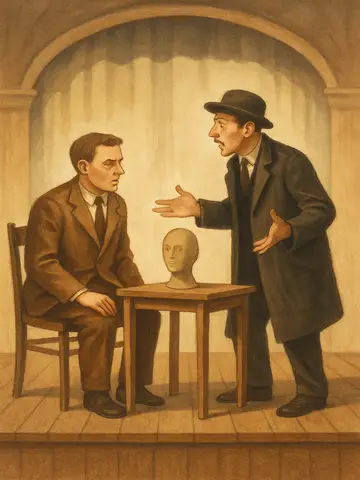
The Theatre of the Absurd, founded in 1952, represents a radical break with traditional theatrical conventions. Born in a post-war context marked by existential questioning and disarray at a world without apparent meaning, this movement changed the codes of classical theatre by exploring the irrationality and absurdity of the human condition through new and confusing forms.
Origins and birth of the Absurd Theatre in 1952
The Absurd Theatre finds its roots in the period after World War II, a time when humanity is confronted with violence, loss of landmarks and a deep sense of alienation. It was in 1952 that this theatrical current officially took shape, thanks in particular to the publication of essays which theorized this new approach, such as that of Eugene Ionesco. The very term « theatre of the absurd » was popularized by the critic Martin Esslin, who emphasized how these works reflected the absurdity of the human condition, breaking with logic and classical narrative. This theatre rejects the linearity of the narrative, the psychological realism and the faithful representation of the real, to favour illogicalism, nonsense and repetitive situations.
Main authors and founding works of the movement
Among the emblematic figures of the Absurde Theatre, Eugene Ionesco and Samuel Beckett occupy a central position. Ionesco, with pieces like The Bald Ghost (1950) and Lesson (1951), perfectly illustrates the absurdity of language and human relations. Beckett, on the other hand, marked the movement with Waiting for Godot (1952), a flagship work that showcases the endless and meaningless expectation of two characters, Vladimir and Estragon. These playwrights were able to capture the existential anguish of their time by deconstructing the traditional theatre, paving the way for a new reflection on the absurdity of life, communication and time.
The Absurd Theatre, born in 1952, remains a major milestone in the history of modern theatre. Through his rejection of classical norms and his exploration of the paradoxes of human existence, he continues to influence playwrights and spectators, inviting a deep meditation on the meaning – or lack of sense – of our condition. This movement has thus opened a new theatrical era, where nonsense becomes a powerful form of artistic expression.