

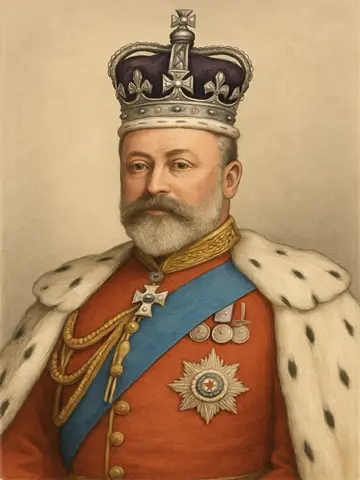
Edward VII, who rose to the throne of the United Kingdom in 1901, marked an era of notable transition between Victorian times and the early twentieth century. The son of Queen Victoria, her reign, although relatively short, laid the foundation for political and social modernization, while strengthening Britain's international position. This king, often perceived as a symbol of change, was able to reconcile monarchical tradition with the innovations needed in a changing era.
The reign of Edward VII: a major transition in 1901
The arrival of Edward VII in 1901 coincided with the end of an era deeply marked by the long regency of his mother, Victoria. His accession to the throne gave a new breath to the British monarchy, often described as « Beautiful Age » thanks to its elegant lifestyle and taste for arts and diplomacy. This period is characterized by a desire to open up and modernize, particularly in international relations, where Édouard VII plays a crucial role in forging strategic alliances, particularly with France, leading to the cordial Agreement. Its reign thus symbolizes a major political and cultural transition, preparing the United Kingdom for the challenges of the twentieth century.
Innovations and challenges under King Edward VII of the United Kingdom
During the reign of Edward VII, Britain faced major challenges, ranging from domestic political tensions to rapid social developments. The king, known for his diplomatic skill, encouraged the modernization of the British navy and supported progressive social reforms, while maintaining an accessible and popular monarchical image. However, his reign also had to deal with growing social movements and imperial tensions, particularly in Africa and Asia. Edward VII managed to navigate these complexities with pragmatism, thus preparing the country to face the upheavals that would follow in the coming decades.
In short, the reign of Edward VII in 1901 was a pivotal moment in the history of the United Kingdom. This king was able to embody a peaceful and dynamic transition between two epochs, modernizing the monarchy while affirming British power on the world stage. His legacy, although sometimes overshadowed by his mother or son George V, remains fundamental to the political and social evolution of Britain at the beginning of the twentieth century.