

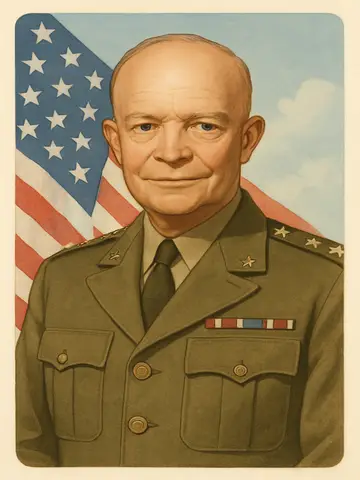
Dwight D. Eisenhower, hero of the Second World War and emblematic figure of American history, became the 34th president of the United States in 1953. His inauguration marks the beginning of a new era, both politically and militarily, in a world context tense by the Cold War. This article explores his accession to the presidency and the main challenges he faced as soon as he took office.
Dwight D. Eisenhower and his presidential inauguration in 1953
On 20 January 1953, Dwight D. Eisenhower took the oath as President of the United States, after a campaign marked by hope for strong and pragmatic leadership. Former chief general of the allied forces in Europe, he enjoys immense popularity and an image of seriousness and competence. His inauguration takes place in an atmosphere of waiting, where the American people want a return to stability after the years of war and international tensions. Eisenhower promised to promote peace while strengthening national security, a delicate balance to be maintained.
The major challenges of Eisenhower's mandate since 1953
As soon as he arrived at the White House, Eisenhower faced enormous challenges. Internationally, the Cold War imposed constant vigilance in the face of Soviet expansion, particularly in Europe and Asia. It must manage the end of the Korean war, find solutions to the nuclear arms race, and maintain strategic alliances such as NATO. Domestically, he inherits a country in the midst of economic and social transformation, where fear of communism causes strong political pressure, illustrated by Senator McCarthy's witch hunt. Eisenhower adopts a policy of moderation and prudence, seeking to stabilize the nation while modernizing infrastructure, such as the creation of the inter-state motorway system.
The inauguration of Dwight D. Eisenhower in 1953 opened a crucial chapter in American history, marked by the desire to reconcile military strength with prudent diplomacy. Faced with both international and domestic challenges, his leadership profoundly influenced the leadership of the United States during the Cold War. His presidency remains an example of political pragmatism and balanced management in a period of intense global tensions.