

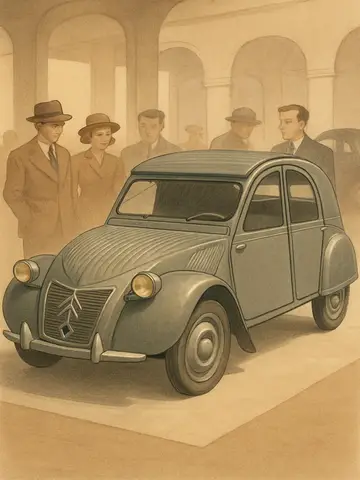
The Paris Motor Show of 1948 marked a major turning point in the history of French automobiles with the official presentation of the Citroën 2CV. This vehicle, which was to become a national icon, surprised the public with its simple yet ingenious design, embodying the post-war spirit and the needs of a society in the midst of reconstruction.
The Citroën 2CV unveiled at the Paris Salon 1948
At the 1948 edition of the Motor Show, Citroën lifted the veil on the 2CV, a model specially designed to meet the demands of a French population seeking affordable and practical mobility. Its minimalist silhouette, economical motor and light chassis immediately attracted attention. This modest but functional vehicle was a direct response to the economic and material difficulties of the time, allowing a large public access to the car for the first time.
A revolutionary model for the French post-war period
The Citroën 2CV was not just a car, but a real social and industrial revolution. It embodied the desire to modernize rural France by facilitating daily travel, whether for work, commerce or leisure. With its flexible suspensions adapted to often difficult roads and reduced fuel consumption, the 2CV quickly became a symbol of simplicity, robustness and technical ingenuity. His presentation at the Paris Motor Show marked the beginning of a new era for popular automobiles, making mobility accessible to all in a context of national reconstruction.
The Citroën 2CV presented at the Paris Motor Show in 1948 remains a fundamental step in the history of automobiles. A true reflection of post-war aspirations, it has combined economy, functionality and innovation to become a French legend. Its success has long influenced the design of popular cars and continues to evoke the period of hope and renaissance that followed the Second World War.