

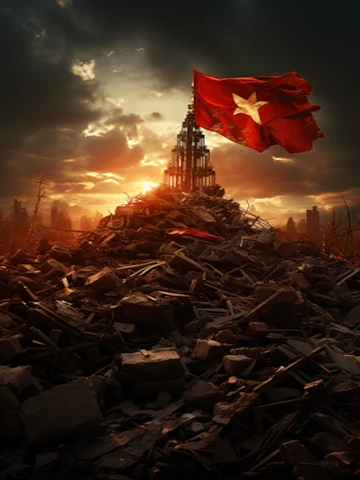
The fall of the Soviet Union in 1991 marked one of the most significant events of the twentieth century, ending more than seven decades of communist rule in Eastern Europe and Central Asia. This geopolitical upheaval has profoundly changed the political map of the world and has had a major impact on the international scene. To understand this fall, it is essential to examine the root causes that have undermined the Soviet Union and the crucial events that precipitated its dissolution in 1991.
The root causes of the fall of the Soviet Union
The fall of the Soviet Union cannot be attributed to a single factor, but rather to a complex combination of economic, political, social and ideological problems. Economically, the USSR suffered from chronic stagnation due to inefficient centralised planning, lack of innovation and a heavy bureaucracy that stifled productivity. Politically, the Soviet regime was weakened by increasingly contested authoritarian governance, a closed and repressive system, and by the growing aspirations of the various republics for greater autonomy. Socially, Soviet society was marked by disillusionment with communist ideology, exacerbated by the rise of nationalist movements and demands for freedom of expression. Finally, the opening initiated by Mikhail Gorbachev through perestroika (restructuring) and glasnost (transparency) liberated the debates but also internal tensions, revealing the weaknesses of the system.
Key events in 1991 in the USSR
The year 1991 was the scene of dramatic events that accelerated the collapse of the Soviet Union. In August, a failed coup d'état by Communist Party conservatives against Gorbachev profoundly shaken the central power and strengthened the independence movements in the republics. Boris Yeltsin, then President of the Soviet Socialist Federal Republic of Russia, became an emblematic figure of resistance at the blow and gained popularity. Then, in the autumn, several republics, beginning with the Baltic States, declared their independence with the gradual recognition of the international community. On 8 December 1991, the leaders of Russia, Ukraine and Belarus signed the Minsk Agreement, which officially announced the end of the Soviet Union and the establishment of the Commonwealth of Independent States (CIS). On 25 December Gorbachev resigned as president, putting a definitive end to the existence of the USSR.
The fall of the Soviet Union in 1991 remains a major historical turning point that has reshaped the world landscape, paved the way for a new political and economic era and raised hopes and challenges for the peoples concerned. While this dislocation ended a totalitarian regime, it also left behind a complex legacy and tensions that, in some cases, still persist today. Understanding the causes and events of this period is essential to better understand the current dynamics in the former Soviet republics and on the international stage.