

The appearance of life on Earth, about 3.8 billion years ago, marks a fundamental event in the history of our planet. This time, still distant and mysterious, corresponds to the emergence of the first forms of primitive life in a very different environment than we know today. Understanding the origins of life and the conditions that led to this appearance not only sheds light on our past, but also on the complex mechanisms that govern biological evolution.
The origins of life 3.8 billion years ago
Nearly 3.8 billion years ago, the Earth was already a changing planet, still marked by intense geological activities and unstable climate. It was at that time that the first complex organic molecules began to assemble, giving birth to the very first living organisms, probably very simple unicellular forms. These primitive beings, often assimilated to bacteria or archaeus, have evolved in aqueous environments, probably in chemically rich oceans. This step is crucial as it lays the foundation for all future biodiversity, initiating a long process of evolution and diversification.
Conditions conducive to the emergence of primitive life
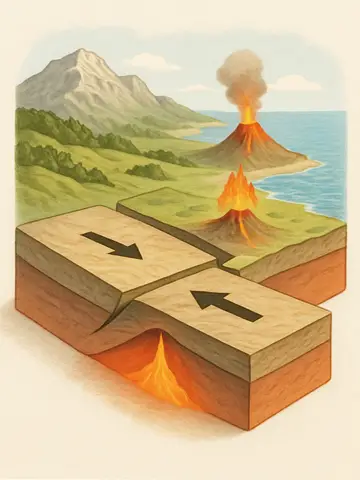
Environmental conditions 3.8 billion years ago were a unique mix of factors conducive to life formation. The presence of liquid water, essential to any biological chemical reaction, combined with a primitive atmosphere composed mainly of gases such as methane, ammonia and carbon dioxide, created a fertile chemical environment. In addition, underwater hydrothermal sources, where thermal energy and various minerals are abundant, have probably offered ideal niches for the development of the first cells. These conditions, combined with phenomena such as lightning or solar radiation, could trigger the chemical reactions necessary for the synthesis of the first organic molecules, paving the way for life.
The appearance of life on Earth 3.8 billion years ago remains an exciting mystery, at the crossroads of geology, chemistry and biology. By studying this distant era, scientists continue to discover how seemingly hostile conditions have been able to provide a fertile ground for the birth of life. This inaugural moment is the starting point for an incredible biological adventure that will lead to the diversity of life we know today.