

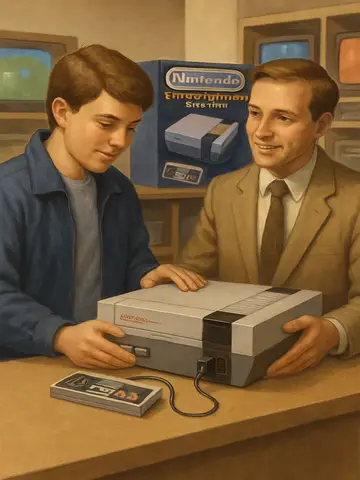
In 1985, the Nintendo Entertainment System (NES) marked a turning point in the history of video games. This console, which was launched in Japan under the name of Famicom in 1983, experienced its major introduction into North America in 1985, revolutionizing the way players interacted with home video games. Its arrival not only brought a crisis industry back to life, but also laid the foundation for a new economic and cultural model for salon consoles.
The revolutionary release of the NES in 1985
The NES was officially launched in North America in October 1985, after a resounding success in Japan. This release was a major event, as it introduced advanced technology for the time, with colorful graphics, better sound quality and an easy to handle controller. Nintendo has demonstrated an innovative marketing strategy, selling the console not as a simple game machine, but as a complete entertainment system, often presented with the R.O.B. companion robot. In addition, the NES introduced iconic titles such as Super Mario Bros. and The Legend of Zelda, which would become timeless classics and global cultural references.
Impact of NES on the video game industry since 1985
The release of the NES in 1985 had a profound and immediate impact on the video game industry. After the market crash in 1983, Nintendo managed to restore consumer and distributor confidence through strict control over the quality of games through a rigorous licensing system. This helped avoid market saturation by poor securities that had contributed to the previous fall. NES has also popularized new types of games and has encouraged the creativity of developers. In addition, it renewed interest in video game as a form of mainstream entertainment, paving the way for exponential growth in the following decades.
The release of the NES in 1985 represents a pivotal moment in the history of video game. By redefining technical, commercial and cultural standards, the NES has not only saved an industry in difficulty, but has also created a video-based tradition that continues to influence modern consoles. Its legacy continues today, making this console a real pillar of world popular culture.